
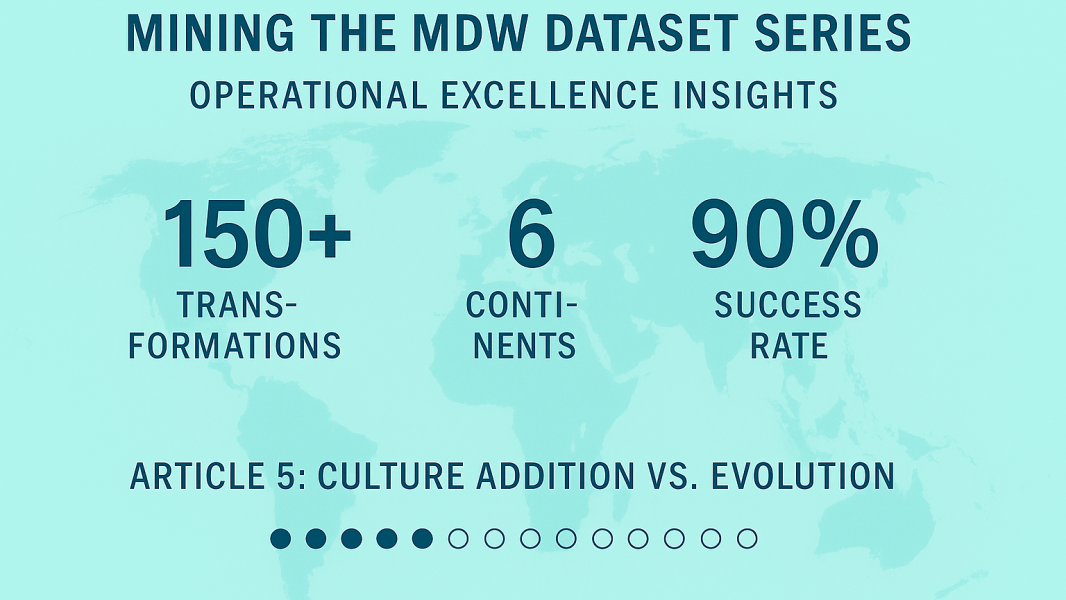
Culture Addition vs. Culture Evolution: Why Integration Beats Implementation

Chris Theron
Most change initiatives fail because they try to add new culture on top of old culture. That’s like painting over rust.
After analysing 150+ organisational transformations using Mission-Directed Work Teams, I’ve identified the #1 predictor of sustainable change: whether leaders try to add culture or evolve culture.
The difference determines whether transformation lasts years or months.
The Addition Trap
Culture addition sounds logical: Take your existing culture, add some new behaviours, and get improved results.
What It looks like:
- New programs alongside existing processes
- Additional meetings on top of current schedules
- Extra training beyond existing responsibilities
- Separate improvement initiatives running parallel to daily work
Why it feels right:
- Less disruptive to current operations
- Doesn’t require stopping existing activities
- Feels like building on strengths
- Appears respectful of current culture
Why it fails:
- Old habits are stronger than new programs
- People default to what they’ve always done under pressure
- Competing priorities dilute focus and energy
- New culture never gets deep enough roots to survive stress
The Evolution Alternative
Culture evolution means using change initiatives to become the kind of organisation you want to be, not just adding activities you want to do.
What It looks like:
- Transforming or replacing existing meetings instead of adding new ones
- Evolving or replacing current processes instead of creating parallel ones
- Integrating improvement into daily work instead of making it extra work
- Using change as the vehicle for becoming, not just doing
The Integration Success Stories
Global Commodities Trader and Processor: DNA as Operating System
A Global Commodities Trader and Processor didn’t add their DNA Program (Develop New Aptitudes) on top of existing operations. They made it the cornerstone of their Industry Master Plan.
- The approach: MDW principles became embedded in how work was structured, measured, and improved across Brazil, Peru, Paraguay, Argentina, Uruguay, China, and India.
- The insight: “The success of MDW globally shows that while cultures differ, the need for meaning, contribution, and ownership is universal.”
- Result: A globally harmonised approach to performance that adapted to local cultures while maintaining consistent excellence standards.
BHP Billiton: BAOS as Cultural Foundation
BHP Billiton didn’t implement MDW alongside their operations – they made MDW the foundation of their BHP Aluminium Operating System (BAOS).
- The integration: MDW became the cultural backbone that made technical excellence sustainable across multiple global sites.
- The transformation: “MDW became the cultural backbone within a global transformation… anchored in leadership, accountability, and shared value creation.”
- Result: Sustained Zero Harm KPIs, lower conversion costs, and stronger team-level accountability because culture and operations evolved together.
Reusable Plastic Packaging Producer: RPMS as Unified Identity
A European based Reusable Plastic Packaging Producer faced a complex challenge: 20+ years of mergers had created disparate systems, values, and cultures across 13 plants in 50+ countries.
- The solution: RPMS (Repetitive Performance Manufacturing Standards) didn’t replace local practices—it evolved them into a unified system rooted in MDW principles.
- The philosophy: “RPMS is not just a system – it’s how we do our job every day.”
Results:
- OEE improved by over 20 points
- Availability increased by more than 25 points
- Over 3,000 improvement ideas generated and shared across sites
- A unified culture of transparency, accountability, and best-practice sharing
The Research Foundation
McKinsey’s research on organisational health shows that companies with strong, aligned cultures outperform peers by 30% in equity returns and 70% in revenue growth.
But here’s the crucial finding: culture change takes 3-5 years to fully embed, and success depends on integration, not addition.
Why? Because culture isn’t what you do in addition to work – culture is how you do work. You can’t change culture by adding activities; you change culture by evolving activities.
Why Addition Feels Safer (But Isn’t)
The Disruption Illusion
Addition feels less disruptive because it doesn’t require stopping current activities. But it creates the exhausting reality of doing everything you used to do plus everything new you’re trying to do.
The Respect Myth
Addition feels more respectful of existing culture. But it actually disrespects culture by treating it as unchangeable rather than evolvable.
The Control Comfort
Addition feels more controllable because you can always stop the new program if it doesn’t work. But this escape hatch mentality prevents the deep commitment needed for real change.
The Speed Trap
Addition appears faster because you can start immediately without changing existing systems. But it’s actually slower because new habits never get strong enough to replace old ones.
The Evolution Framework
Based on successful transformations, culture evolution follows a predictable pattern:
1. Integration Over Addition
- Instead of: New improvement meetings Do: Transform existing meetings to include improvement
- Instead of: Separate training programs Do: Embed learning into daily work processes
- Instead of: Additional measurement systems Do: Evolve current metrics to drive better behaviours
2. Replacement Over Accumulation
- Instead of: Adding new processes alongside old ones Do: Replace ineffective processes with better ones
- Instead of: Parallel systems for transformation Do: Single systems that embody transformation
3. Evolution Over Revolution
- Instead of: Dramatic changes that shock the system Do: Systematic changes that strengthen the system
- Instead of: Abandoning everything that exists Do: Building on what works while fixing what doesn’t
What Evolution Looks Like in Practice
Global Food and Beverage Manufacturer’s Meeting Evolution
This FMCG giant didn’t add MDW meetings to existing meeting structures. They evolved existing meetings to embody MDW principles.
- Production meetings became problem-solving sessions
- Management reviews became coaching conversations
- Performance discussions became capability development opportunities
Result: Same time investment, dramatically different outcomes.
Premium Beverages Producer’s System Integration
A Beverages Producer based in Africa didn’t create separate improvement systems alongside their brewing operations. They integrated MDW into their Premium Beverage Production Operating System.
- The transformation aligned with World Class Manufacturing principles but used MDW as the cultural foundation that made technical excellence sustainable.
Result: Production Plan Attainment improved from 90.2% to 95.0% over three years, with sustainable culture change embedded in daily operations.
The Hard Questions Evolution Requires
What Will We Stop Doing?
Evolution requires subtraction, not just addition. What current activities, meetings, or processes will you eliminate to make room for better ones?
How Will We Change, Not Just What?
Evolution focuses on how you do existing work differently, not just what new work you’ll add.
Who Will We Become, Not Just What Will We Do?
Evolution asks identity questions: What kind of organisation do we want to become? How do we embody those qualities in our daily operations?
The Integration Diagnostic
Addition signals:
- Separate scorecards for transformation initiatives
- Different language for improvement vs. operations
- Extra time required for transformation activities
- Parallel systems that compete for attention
Evolution signals:
- Single scorecards that integrate excellence with operations
- Common language that describes both work and improvement
- Transformation embedded in how work gets done
- Unified systems that strengthen each other
Why Evolution Takes Courage
Evolution is harder than addition because it requires:
Admitting current culture isn’t perfect
- Addition lets you keep everything and just add good stuff
- Evolution requires acknowledging what needs to change
Making irreversible commitments
- Addition allows easy retreat to old ways
- Evolution burns bridges to old patterns
Trusting the process during discomfort
- Addition provides the safety of familiar fallbacks
- Evolution requires faith during the messy middle
Leading change instead of managing addition
- Addition can be delegated to program managers
- Evolution requires leadership transformation
The Monday Morning Reality
If you’re adding culture:
- You’ll have competing priorities and divided attention
- People will revert to old patterns under pressure
- Improvements will plateau when initial enthusiasm wanes
- Change will feel like extra work, not better work
If you’re evolving culture:
- You’ll have integrated systems that reinforce each other
- People will default to new patterns because they’re the only patterns
- Improvements will compound because they’re embedded in daily work
- Change will feel like natural growth, not imposed burden
The Long-Term Choice
- Culture addition creates temporary improvement layered on permanent systems. When pressure mounts, people strip away the additions and revert to core patterns.
- Culture evolution creates permanent improvement embedded in renewed systems. When pressure mounts, people rely on stronger, better patterns that handle stress more effectively.
The Ultimate Test
Here’s how to know if you’re adding or evolving:
Ask your frontline teams: “Is this transformation something you do in addition to your job, or is it how you do your job?”
- Addition answer: “It’s extra work we do for improvement”
- Evolution answer: “It’s just how we work now”
The Paradox of Integration
The organisations that try to change everything at once often change nothing permanently. The organisations that systematically evolve how they do everything often transform completely.
Addition is fast and temporary. Evolution is gradual and permanent.
The question isn’t whether you want change – it’s whether you want change that lasts.
Are you adding to your culture or evolving it? How do you know when transformation has become “just how we work” rather than “extra work we do”? Share your experience with sustainable vs. temporary change.