
The Union Partnership Secret: How Adversaries Become Allies

Chris Theron
The sites with the strongest union presence often achieved the best results. Here’s why that surprised everyone.
When executives discuss operational excellence initiatives, union involvement often triggers nervous conversations about “managing resistance” and “getting buy-in.” The assumption is clear: unions are obstacles to transformation.
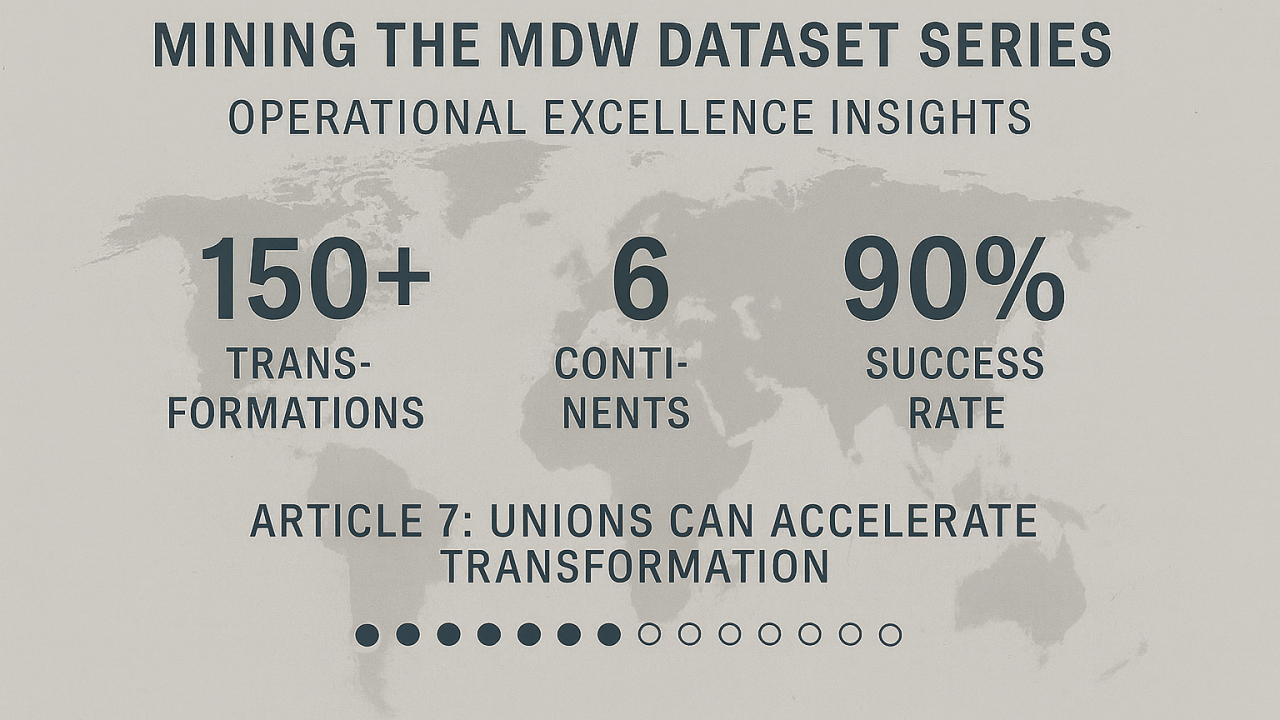
After analysing 150+ implementations, several of them across heavily unionised environments, I’ve discovered something that challenges this assumption: the strongest union sites often achieved the most dramatic results.
Not despite union involvement – because of it.
The Conventional Wisdom (And Why It’s Wrong)
Traditional thinking about unions and change:
- Unions resist change because it threatens job security
- Collective bargaining prevents individual accountability
- Union culture conflicts with performance culture
- Seniority systems block merit-based recognition
What our analysis reveals:
- Strong unions can accelerate change when properly engaged
- Collective voice often supports collective responsibility
- Union culture and excellence culture share common values
- Organised labour can be organised improvement
The Partnership Success Stories
Continental Tyre SA: From Resistance to Reference
Continental Tyre SA faced a complex challenge: 1,559 employees across 17 shifts per week in a heavily unionised environment. Previous MDW attempts had stalled due to union resistance.
The turning point: Instead of trying to work around the union, leadership made union involvement central to the strategy.
Partnership approach:
- Early alignment sessions with union leadership
- Transparent communication about goals and methods
- Joint problem-solving on implementation challenges
- Shared ownership of results and recognition
Results:
- Dramatic throughput improvements and cultural transformation
- Union representatives became active champions, even presenting at Show & Tell conferences
- Sustainable change that survived multiple leadership transitions
Key insight: Union resistance often signals poor change process and mistrust, not anti-improvement sentiment.
UTi Material Handling: Engagement Through Inclusion
UTi Material Handling operated in a unionised logistics environment where previous initiatives had created adversarial relationships.
The breakthrough: Leadership included union representatives in kick-off workshops and ongoing coaching review cycles.
Partnership elements:
- Union involvement in team structure design
- Transparent discussion of KPI relevance and fairness
- Joint resolution of space constraints and implementation challenges
- Shared celebration of team achievements
Results:
- Enhanced clarity on performance expectations at all levels
- Cultural transformation that union representatives actively supported
- Sustainable practices embedded across shifts and departments
Leadership reflection: “Your business is unique, just like everybody else’s. But this works” – including in unionised environments.
SABMiller Honduras: Transformation Through Trust
SABMiller’s Honduras operations faced a deeply entrenched “us vs them” mentality with union delegates dominating supervisory roles and conflict resolution automatically escalating to HR.
The partnership strategy:
- Early engagement with union leadership in transformation planning
- Transparent communication about business challenges and improvement goals
- Joint training programs that developed both management and union representatives
- Shared governance of improvement initiatives
Transformation results:
- 88+ teams live across operations and functions
- Cultural shift: From union-led to operator-led teams with high morale and ownership
- Performance gains: Brewery and CSD Plant ranked in SABMiller’s global Top 10
- Sustainable partnership: Change survived ownership transitions and economic pressures
Why Strong Unions Can Accelerate Change
Organised Voice = Organised Commitment
- The insight: Unions are fundamentally about collective action. When that collective action aligns with improvement rather than resistance, the results are powerful.
- Traditional view: Union organisation opposes management efficiency
- Partnership reality: Union organisation can accelerate systematic improvement once trust is earned.
Credibility Through Independence
Union endorsement often carries more weight with frontline employees than management endorsement because it comes from independent representation.
Example: When Continental’s union representatives began presenting MDW success stories, employee skepticism disappeared faster than it would have through management communication alone.
Shared Values, Different Expression
Common values between union culture and excellence culture:
- Safety first: Both prioritise worker protection
- Dignity and respect: Both demand fair treatment
- Skill development: Both support worker advancement
- Voice and participation: Both want employee input valued
- Job security: Both benefit from competitive operations
The difference: Expression through adversarial negotiation vs. collaborative improvement.
The Partnership Framework That Works
1. Start with Shared Interests
- Instead of: Focusing on areas of disagreement
- Do: Identify common ground around safety, job security, skill development, and fair treatment
- Continental example: Both management and union wanted safer workplaces and sustainable employment – MDW delivered both.
2. Transparency Over Tactics
- Instead of: Managing information to minimise resistance
- Do: Share business realities, improvement goals, and implementation plans openly
- UTi example: Transparent discussion of space constraints and KPI challenges created joint problem-solving instead of separate blame.
3. Joint Problem-Solving Over Separate Planning
- Instead of: Developing plans and then “selling” them to unions
- Do: Include union representatives in design and implementation planning
- SABMiller example: Joint training programs developed both management and union capabilities simultaneously.
4. Shared Success Over Zero-Sum Thinking
- Instead of: Improvement benefiting management at union expense
- Do: Structure improvements that clearly benefit both operational performance and worker experience
- Pattern across sites: Safety improvements, skill development, and workplace organisation created win-win outcomes.
The Research Foundation
MIT’s research on labour-management partnerships shows that collaborative relationships outperform adversarial ones on virtually every measure: productivity, quality, innovation, and even worker satisfaction. Yet many managers pride themselves in their adversarial conquests with unions.
Harvard Business School studies demonstrate that high-involvement workplaces with strong union partnerships achieve superior performance compared to either weak unions or union-free environments.
Why: Organised voice + systematic improvement = accelerated results.
What Partnership Actually Looks Like
Early Engagement, Not Late Buy-In
- Partnership approach: Include union leadership in initial planning conversations
- Traditional approach: Develop plans, then seek union “buy-in”
- Result: Ownership vs. suspicious compliance
Joint Training, Not Parallel Programs
- Partnership approach: Train union representatives alongside managersin improvement methodologies
- Traditional approach: Train management, then “cascade” to union members
- Result: Shared capability vs. information gaps
Collaborative Recognition, Not Management Awards
- Partnership approach: Joint celebrationof team achievements and individual contributions
- Traditional approach: Management-driven recognition programs
- Result: Authentic appreciation vs. perceived manipulation
Shared Governance, Not Consultation
- Partnership approach: Union representationin improvement steering committees and review processes
- Traditional approach: Periodic consultation on predetermined plans
- Result: True partnership vs. managed participation
The Diagnostic Questions
How do you know if you’re building partnership or managing resistance?
Decision-Making Test
- Are union representatives involved in designing improvement initiatives, or just responding to them?
Information Test
- Do union leaders have the same information as management about business challenges and improvement goals?
Success Test
- Do union representatives feel that improvement success benefits their members, or just management objectives?
Voice Test
- Can union feedback actually change improvement plans, or is “input” just ceremonial?
Why This Approach Takes Courage
Vulnerability About Business Reality
Partnership requires honest communication about competitive pressures, financial challenges, and improvement imperatives – information that feels risky to share.
Shared Control Over Solutions
Partnership means union input can actually change management’s preferred approach – which requires flexibility and humility.
Long-Term Thinking Over Short-Term Control
Partnership requires investing in relationship building rather than pushing through quick implementations.
Trust Over Protection
Partnership requires believing that union representatives want success rather than assuming they want to create problems.
The Monday Morning Reality
If you’re planning change in a unionised environment:
Stop thinking:
- “How do we minimise union resistance?”
- “What’s the least we need to share?”
- “How do we get them to accept our plan?”
Start asking:
- “How do we make this genuinely beneficial for union members?”
- “What business information would help union leaders understand our situation?”
- “How can union representatives help us design better solutions?”
Immediate actions:
- Schedule early conversations with union leadership about business challenges and improvement opportunities
- Share relevant business data that explains why change is necessary
- Ask for union input on how to structure improvements fairly and effectively
- Create joint governance structures for ongoing improvement oversight
The Counter-Intuitive Truth
Strong unions don’t prevent operational excellence – weak relationships do.
When union representatives understand business realities, share improvement goals, and have genuine voice in solutions, they often become the most effective change agents in the organisation.
Why: They have credibility with workers that management can never achieve, and they have motivation for sustainable solutions that external consultants can never match.
The Long-Term Advantage
- Adversarial relationships create short-term compliance and long-term resistance.
- Partnership relationships create short-term investment and long-term acceleration.
Organisations that build genuine union partnerships don’t just implement change faster – they build change capability that outlasts any specific initiative.
The Choice
- You can treat unions as obstacles to manage, or as partners to engage.
- You can assume labour-management interests conflict, or discover where they align.
- You can implement change to workers, or develop change with workers.
The sites that achieved breakthrough results chose partnership. The question is whether you will.
Have you experienced union partnerships that accelerated rather than hindered change? What shifted the dynamic from adversarial to collaborative? Share your insights on building bridges instead of walls.