
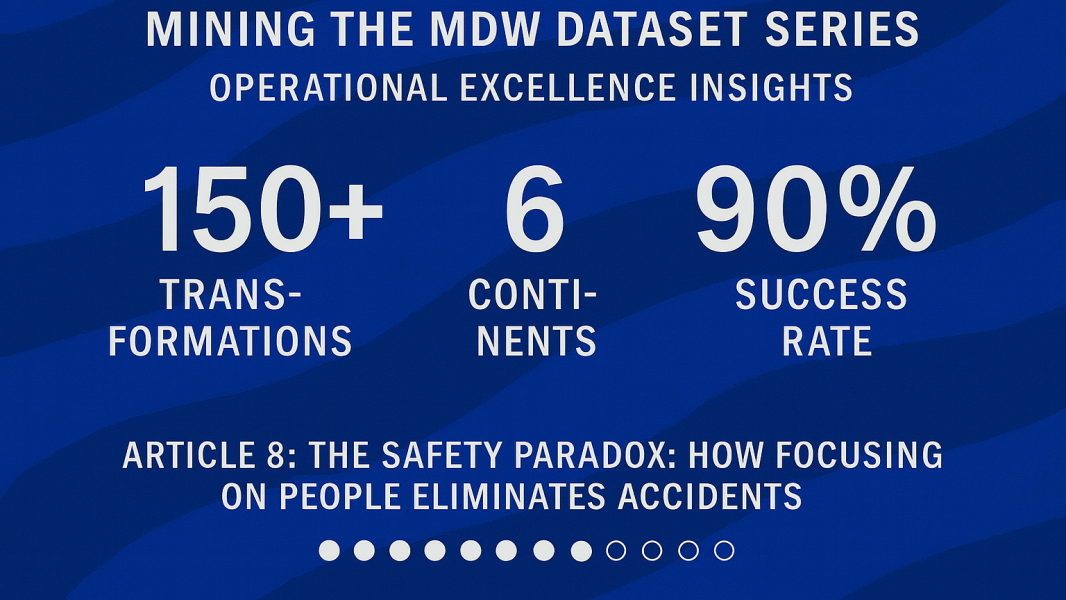
The Safety Paradox: Focusing on People Eliminates Accidents

Chris Theron
The safest companies don’t focus on safety. They focus on something else entirely.
Every safety manager knows the statistics: workplace accidents cost organisations billions annually in direct costs, insurance premiums, productivity losses, and regulatory penalties. The traditional response? More safety training, stricter procedures, additional oversight.
After analysing safety outcomes across 150+ operational transformations, I’ve discovered a paradox that challenges conventional safety wisdom:
the organisations that achieved zero accidents weren’t trying to eliminate accidents – they were trying to eliminate something else entirely.
The Traditional Safety Approach Plateau
Conventional safety management focuses on:
- Compliance with regulations and procedures
- Training employees on safety rules
- Investigating accidents after they occur
- Measuring incident rates and near-misses
- Enforcing safety behaviours through oversight
This approach typically achieves regulatory compliance, reduction in obvious hazards, improved incident reporting and improved basic safety awareness. Yet that is where it plateaus because people follow the what without understanding the whyand compliance becomes checkbox behaviour making safety feel separate from “real work”. In many instances, safety gets in the way of efficiency, motivating unsafe behaviour “when the pressure is high and no one is looking”.
The Paradox Companies That Achieved Zero
Lao Tobacco Limited: 1.5 Years Without Lost Time Accidents
- What they didn’t do: Implement additional safety programs
- What they did: Create Listen to Learn (L2L) initiatives where leaders shadowed frontline roles
- The transformation: When leaders understood work realities, they addressed root causes of unsafe conditions rather than just unsafe behaviours.
- Safety result: 1.5 years without LTA with 2,149 near-miss reports exceeding stretch targets
- The insight: Safety improved because communication and trust improved.
Shatterprufe Struandale: 753 Consecutive Days Without LTA
- What they didn’t do: Focus primarily on safety metrics
- What they did: Gave frontline workers ownership and a voice for safety
- The transformation: When workers became valued and empowered, they naturally protected themselves and each other.
- Safety result: 753 consecutive days without LTA (compared to 269 days before MDW)
- The insight: Safety improved because of engagement and ownership.
Dorbyl Automotive Systems: Zero Disabling Injuries
- What they didn’t do: Add more safety oversight
- What they did: Create a culture where workers had genuine voice in problem-solving and improvement
- The transformation: When people felt responsible for outcomes, they took responsibility for conditions.
- Safety result: Zero disabling injuries with highest internal safety rating
- The insight: Safety improved because responsibility and pride improved.
Sugarbird: From 17 Injuries to Zero
- What they didn’t do: Implement punishment-based safety systems
- What they did: Focus on leadership style change and cultural transformation
- The progression: 17 injuries (Year 1) → 1 injury (Year 3) → 0 injuries thereafter
- The insight: Safety improved because leadership and culture improved.
The Research That Explains the Paradox
Psychological Safety Creates Physical Safety
Amy Edmondson’s research on psychological safety shows that teams with high psychological safety have lower accident rates because:
- People report problems without fear of blame
- Teams solve problems proactively rather than reactively
- Information flows freely about hazards and near-misses
- Innovation improves both safety and performance
High-Reliability Organisation Studies
Research on high-reliability organisations (airlines, nuclear plants, hospitals) reveals that the safest operations share common characteristics:
- Distributed decision-making authority
- Open communication about problems and failures
- Learning orientation rather than blame orientation
- Collective responsibility for outcomes
Physical safety emerges from organisational health, not safety programs.
What “People Focus” Actually Means for Safety
Voice Without Fear
- Traditional approach: “Report safety violations”
- People-focused approach: “Help us understand what makes work difficult or dangerous”
Example: Imperial Tobacco Taiwan’s 55% increase in near-miss reporting occurred not because of safety campaigns, but because teams felt safe to surface problems.
Ownership Over Compliance
- Traditional approach: “Follow safety procedures”
- People-focused approach: “Take responsibility for safe outcomes”
Example: Anglo American Polokwane’s 52 near-miss reports indicating rising EHS engagement emerged from teams that owned their performance, not just followed rules.
Problem-Solving Over Rule-Following
- Traditional approach: “Procedures cover every situation”
- People-focused approach: “People adapt safely to unexpected situations”
Example: Multiple sites achieved zero LTA records when workers became active problem-solvers rather than passive rule-followers.
The Four Elements of People-Focused Safety
1. Dignity and Respect in Daily Interactions
What this looks like:
- Leaders ask “How can we make this safer?” instead of “Why didn’t you follow procedure?”
- Workers are treated as safety experts, not safety risks
- Problems are solved with people, not imposed on people
Safety impact: People protect what they value, and they value workplaces that value them.
2. Voice and Influence in Safety Decisions
What this looks like:
- Frontline input shapes safety procedures and policies
- Teams can stop work when they identify hazards
- Safety improvements come from worker suggestions, not management mandates
Safety impact: People follow rules they helped create and understand rules they helped design.
3. Capability and Confidence in Problem-Solving
What this looks like:
- Workers are trained to identify and address root causes
- Teams have authority to implement safety improvements
- Problem-solving skills are developed, not just rule-following behaviours
Safety impact: People handle unexpected situations safely because they understand principles, not just procedures.
4. Ownership and Pride in Outcomes
What this looks like:
- Teams track and celebrate their own safety performance
- Safety achievements are recognized as team accomplishments
- Workers feel responsible for each other’s wellbeing
Safety impact: People create safety cultures that sustain themselves through peer accountability and mutual care.
The Implementation Framework
Start with Trust, Not Rules
- Traditional approach: Implement safety rules, then build relationships
- People-focused approach: Build relationships that naturally create safe behaviours
Practical steps:
- Leaders spend time understanding actual work conditions
- Workers have genuine input in safety procedure design
- Problems are solved collaboratively, not punitively
Measure Leading Indicators, Not Just Lagging Ones
- Traditional metrics: Accident rates, injury frequency, compliance scores
- People-focused metrics: Near-miss reporting rates, problem-solving participation, safety suggestion implementation
- Why: Leading indicators predict safety performance; lagging indicators only report it.
Develop Capability, Not Just Compliance
- Traditional training: Rules, procedures, regulations
- People-focused development: Problem-solving, hazard identification, risk assessment thinking
- Result: People who can adapt safely to unexpected situations, not just follow expected procedures.
Why This Approach Works Better
Intrinsic vs. Extrinsic Motivation
- Traditional safetyrelies on external motivation: rules, oversight, consequences
- People-focused safety activates intrinsic motivation: care, responsibility, pride
Research shows: Intrinsic motivation creates more consistent, sustainable behaviour change.
System Thinking vs. Event Thinking
- Traditional safetyfocuses on preventing specific types of accidents
- People-focused safety builds systems that prevent accidents through enhanced capability
Result: Resilience that handles both known and unknown hazards.
Culture vs. Program
- Traditional safetycreates safety programs alongside regular work
- People-focused safety embeds safety excellence into how work gets done
Sustainability: Culture outlasts programs, especially under pressure.
The Diagnostic Questions
How do you know if you’re building safety culture or just safety compliance?
The Problem-Reporting Test
- Do people report near-misses and hazards without fear of blame?
- Are safety problems solved with input from people who do the work?
The Adaptation Test
- Can workers adapt safely to unexpected situations?
- Do people understand safety principles or just safety rules?
The Ownership Test
- Do teams feel responsible for each other’s safety?
- Is safety performance something teams own or something management tracks?
The Innovation Test
- Do safety improvements come from frontline suggestions?
- Are workers actively problem-solving or passively complying?
What This Looks Like Monday Morning
Stop:
- Talking about safety as separate from performance
- Investigating accidents to assign blame
- Implementing safety rules without worker input
- Measuring only accident rates and compliance
Start:
- Asking workers how to make their jobs safer and easier
- Solving safety problems collaboratively
- Developing worker capability to identify and address hazards
- Measuring engagement, voice, and problem-solving participation
Key shifts:
- From “Be safe” to “How can we make this safer?”
- From “Follow procedures” to “Adapt safely”
- From “Report problems” to “Solve problems”
- From “Avoid accidents” to “Create excellent outcomes”
The Counter-Intuitive Truth
Organisations that achieve zero accidents don’t pursue zero accidents – they pursue engaged, empowered, capable people who naturally create safe outcomes.
Safety becomes a byproduct of excellence, not a separate goal competing with performance.
When people feel:
- Valued: They protect what values them
- Capable: They handle challenges safely
- Responsible: They take care of each other
- Heard: They share information about hazards
The result: Safety performance that exceeds what rule-based approaches can achieve.
The Long-Term Choice
You can build safety through control and compliance, achieving basic regulatory performance with constant oversight requirements.
Or you can build safety through engagement and empowerment, achieving exceptional performance that sustains itself through culture.
The safest organisations discovered that when you focus on people, safety takes care of itself.
Have you experienced workplaces where safety improved dramatically without traditional safety programs? What created the conditions where people naturally worked more safely? Share your insights on building safety culture vs. safety compliance.