
Changing Culture Anywhere

Chris Theron
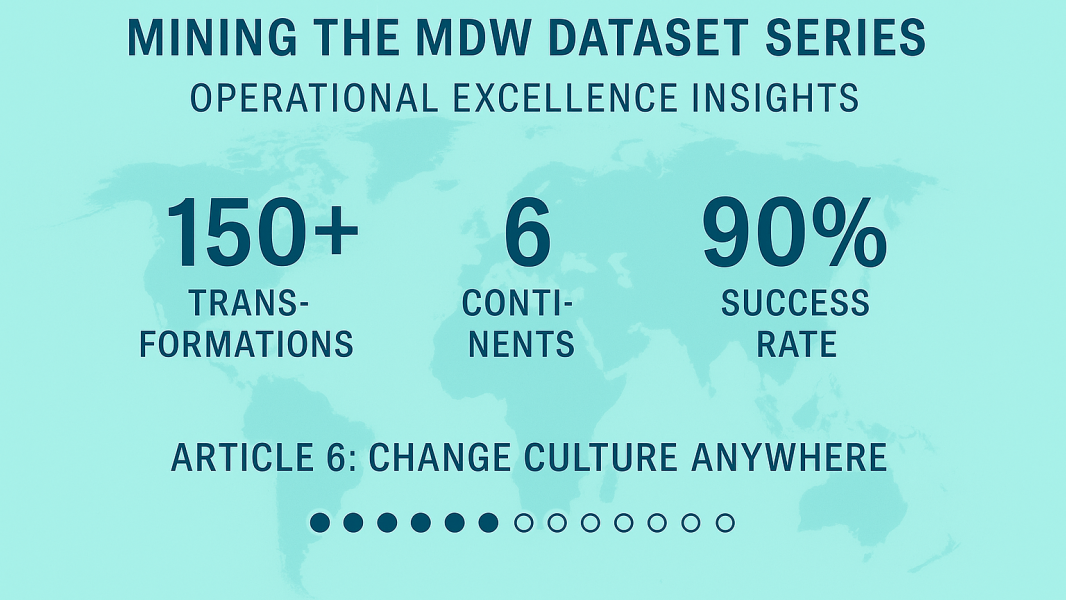
Culture is local, they said. Change doesn’t translate across borders, they said. 150 implementations across 6 continents suggest otherwise.
The most persistent myth in organisational development is that culture change strategies don’t cross borders. “What works in Germany won’t work in Ghana,” executives confidently declare. “Asian hierarchies are too different from American egalitarianism.”
After analysing Mission-Directed Work implementations across six continents – from Uganda to Germany, from Taiwan to Brazil – we’ve discovered something that challenges conventional wisdom:
Universal human needs transcend cultural differences more than cultural differences constrain universal solutions.
The Assumption That Limits Us
The “culture is local” assumption sounds sophisticated and respectful. It acknowledges differences and avoids the arrogance of one-size-fits-all solutions. As it should.
But it creates three dangerous (believed) limitations:
- Paralysis by complexity – “It’s too complicated to scale across cultures”
- Excuse for mediocrity – “Our culture doesn’t support excellence”
- Underestimation of people – “They’re not ready for empowerment / accountability / ownership”
These assumptions often say more about our biases than about cultural realities.
The Global Evidence
From Scandinavia to Sub-Saharan Africa
Global Wheel Manufacturer in Denmark: 450 employees in a structured, egalitarian society
- Challenge: Hierarchical “system company” limiting initiative
- Result: 322 improvement proposals from previously disengaged “Octopuses” (long-tenure employees)
- Key insight: Even in highly organized societies, people want meaningful contribution
Nice House of Plastics Uganda: Founded by Dr. James Mulwana in 1970
- Challenge: Low morale, poor team spirit, language barriers, limited literacy
- Result: >98% attendance, strong team accountability, cultural transformation through “Mulwana Way”
- Key insight: Dignity and respect transcend educational or economic differences
Common thread: Both cultures responded to structured empowerment and visible appreciation – despite vastly different contexts and peoples.
From Ancient Hierarchies to Modern Democracies
Imperial Tobacco Taiwan (ITTM): Highly educated, hierarchical society
- Challenge: Traditional hierarchy limiting frontline input
- Result: 64 → 1,422 improvement ideas (+2,219%), advanced MBU implementation
- Adaptation: Structured authority with empowered execution
Lao Tobacco Limited: Traditional monarchy with limited industrial experience
- Challenge: Vertical integration, limited operational experience
- Result: 1.5 years without LTA, +17.3% OEE in making areas, 1,708 improvement ideas
- Adaptation: “Listen to Learn” initiatives where leaders shadow frontline roles
Common thread: Both cultures embraced systematic improvement when it respected existing authority structures while creating space for contribution.
From Economic Powerhouses to Developing Economies
Nestlé Switzerland (Romont): 45 employees, 24/7 high-tech operation since 1968
- Result: 11% machine downtime reduction, structured problem-solving culture
- Approach: Technical precision with systematic team engagement
Century Bottling Uganda (SABCO): Operating in economy with $303 GNP per capita
- Result: +228% cases per person, 60% workforce reduction while improving performance
- Approach: Same systematic approach adapted to resource constraints
Common thread: Both achieved breakthrough results through structured team systems—regardless of economic development level.
The Universal Human Operating System
Despite vast cultural differences, successful implementations across all geographies shared remarkably similar patterns:
Universal Need #1: Meaning and Purpose
What this looks like everywhere:
- Clear connection between individual work and customer impact
- Understanding how personal contribution affects bigger outcomes
- Visible appreciation for specific contributions
Cultural adaptations:
- Individualistic cultures (US, Germany): Personal achievement recognition
- Collectivist cultures (Taiwan, Uganda): Team achievement celebration
- Same underlying need, different expression
Universal Need #2: Voice and Influence
What this looks like everywhere:
- Structured opportunities to contribute ideas and solutions
- Feedback loops that show input leads to action
- Problem-solving authority at appropriate levels
Cultural adaptations:
- High-power distance (Asia, Africa): Formal suggestion systems with hierarchical approval
- Low-power distance (Scandinavia, Netherlands): Direct team decision-making authority
- Same underlying need, different structure
Universal Need #3: Growth and Mastery
What this looks like everywhere:
- Skill development opportunities embedded in daily work
- Coaching and feedback for continuous improvement
- Clear progression pathways and capability building
Cultural adaptations:
- Long-term oriented (Germany, Taiwan): Systematic skill development programs
- Short-term focused (some African contexts): Immediate capability application
- Same underlying need, different timeline
Universal Need #4: Dignity and Respect
What this looks like everywhere:
- Treatment as capable human beings, not just labor resources
- Trust to make decisions within defined boundaries
- Recognition of expertise and experience
Cultural adaptations:
- Formal cultures (Germany, Taiwan): Structured recognition and clear role definitions
- Informal cultures (Uganda, Brazil): Personal appreciation and relationship building
- Same underlying need, different style
The Adaptation Framework That Works
Successful global implementations don’t ignore cultural differences – they adapt delivery while preserving essence.
High-Context vs. Low-Context Cultures
High-context (Asia, Africa): Visual management and storytelling critical
- Example: Lao Tobacco’s visual workplace transformations and recognition ceremonies
- Adaptation: Rich visual communication, story-based learning
Low-context (Northern Europe, North America): Data-driven approach resonates
- Example: Wheel Giant A, Denmark’s systematic improvement tracking and metric-based recognition
- Adaptation: Clear metrics, logical progression, fact-based decisions
Hierarchical vs. Egalitarian Societies
Hierarchical: Structured rollout with clear authority important
- Example: Imperial Tobacco Taiwan’s MDT1-3 tiered structure respecting organisational levels
- Adaptation: Work within existing authority while expanding influence
Egalitarian: Peer-to-peer coaching and recognition essential
- Example: European Packaging Giant in Schwerin’s Gemba walks as learning opportunities, not inspections
- Adaptation: Collaborative problem-solving, shared leadership
Why Geography Doesn’t Determine Success
The Research Foundation
Daniel Pink’s research on motivation shows that autonomy, mastery, and purpose drive higher performance across cultures. Amy Edmondson’s psychological safety research applies globally. Maslow’s hierarchy of needs has been validated across diverse cultural contexts.
The insight: While cultural expression varies, fundamental human motivations are remarkably consistent.
The Implementation Reality
A Global Commodity Company’s DNA Program spanned Brazil, Peru, Paraguay, Argentina, Uruguay, China, and India. Their conclusion: “While cultures differ, the need for meaning, contribution, and ownership is universal.”
The pattern holds: Systematic empowerment works everywhere when it respects how cultures prefer to express universal human needs.
The Mistakes That Create “Cultural Impossibility”
Mistake #1: Copying Methods Instead of Principles
- Wrong: Apply German systematic processes exactly in Uganda
- Right: Apply systematic thinking adapted to Ugandan communication styles
Mistake #2: Underestimating People
- Wrong: “They’re not ready for accountability”
- Right: “How do we create accountability systems that fit their context?”
Mistake #3: Overestimating Barriers
- Wrong: “Hierarchy prevents empowerment”
- Right: “How do we empower within hierarchy?”
Mistake #4: Cultural Stereotyping
- Wrong: “Asians don’t speak up” or “Americans only care about individual achievement”
- Right: Create systems that work for introverts and extroverts, individual and collective orientations
What This Means for Global Leaders
Start with Universal Principles
- People want meaningful work
- Teams want to solve problems
- Everyone wants to be treated with dignity
- Growth and learning are universally motivating
Adapt Delivery, Not Intent
- Same goal: Frontline empowerment
- Different methods: Authority structures, communication styles, recognition systems
Trust People More Than Stereotypes
- Every culture contains variety within itself
- Individual differences often exceed cultural differences
- People consistently exceed expectations when systems support them
The Monday Morning Reality
If you’re leading global transformation:
Stop saying:
- “Our culture doesn’t support that”
- “It works there but won’t work here”
- “They’re not ready for empowerment”
Start asking:
- “How do we adapt this principle to respect local preferences?”
- “What would empowerment look like in our cultural context?”
- “How do we honor dignity and create growth in our environment?”
Remember:
- Principles are universal; practices are cultural
- Respect differences in how, not whether, people want dignity and growth
- Cultural adaptation strengthens effectiveness; it doesn’t compromise standards
The Surprising Truth
The most “difficult” cultural contexts often produce the most dramatic results because:
- Lower expectations create higher appreciation for respect and empowerment
- Structured approaches work well in contexts hungry for systematic development
- Dignity and growth are especially powerful where they’ve been scarce
- Results speak louder than cultural assumptions
The Choice
You can use cultural differences as reasons why excellence isn’t possible, or you can use cultural wisdom to make excellence more powerful.
You can assume people are limited by their culture, or you can discover how universal human needs express themselves uniquely in every culture.
Geography doesn’t determine whether transformation works. Leadership does.
The question isn’t whether your culture supports excellence. The question is whether your approach to excellence supports your culture.
What cultural assumptions have you discovered were actually universal human needs in disguise? Share your experience with what works everywhere vs. what needs local adaptation.