
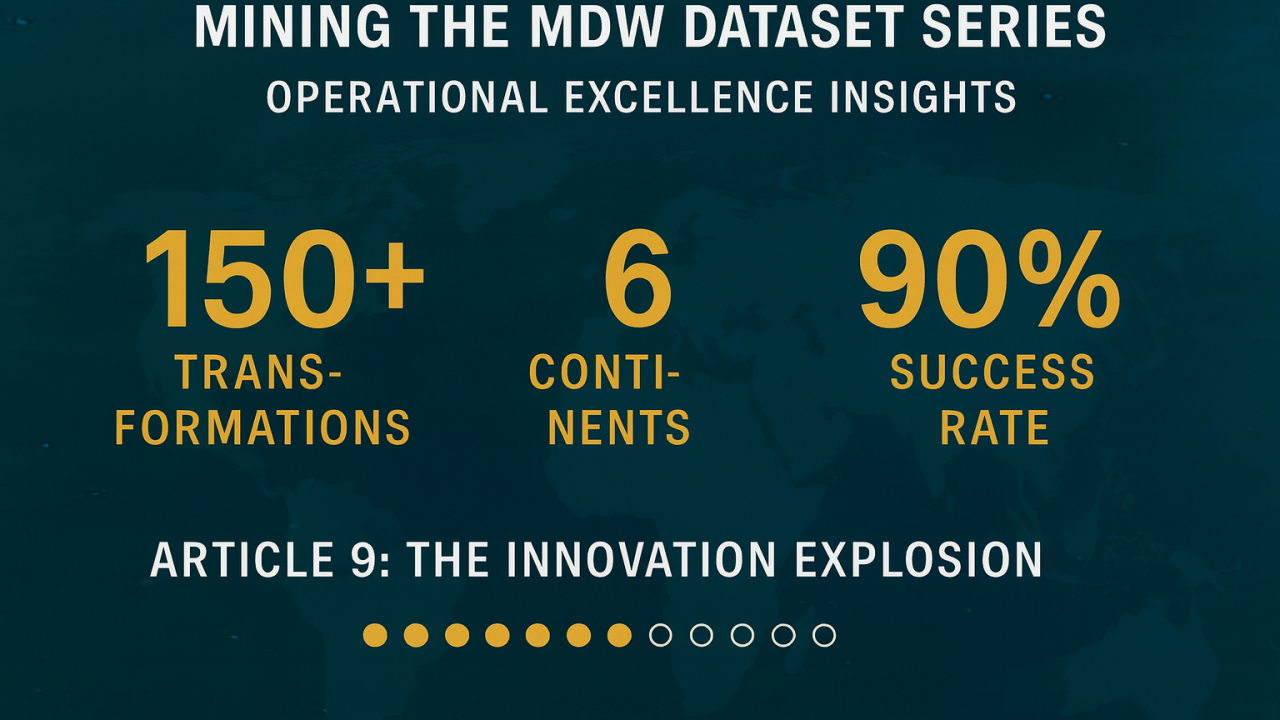
The Innovation Explosion: What Happens When Everyone Becomes a Problem Solver

Chris Theron
Imperial Tobacco Taiwan went from 64 employee suggestions to 1,422 in one year. Here’s what that actually reveals.
Most executives talk about wanting “innovation culture” while implementing suggestion boxes and innovation contests. Then they wonder why they get the same few people submitting predictable ideas, or worse.
After analysing innovation metrics across 150+ organisational transformations, I’ve discovered something remarkable: when you stop trying to manage innovation and start developing problem solvers, innovation explodes.
The numbers are staggering, but the real story is what those numbers represent.
The Innovation Explosion Data
The Breakthrough Cases
- Imperial Tobacco Taiwan: 64 → 1,422 improvement ideas (+2,219%)
- Imperial Tobacco Honduras: 300+ ideas in first 3 months of MBU implementation
- Nestlé Philippines: 14,100 “Just Do It” ideas submitted
- Danish Wheels Giant: 322 improvement proposals from previously disengaged workforce
- Chiron Vaccines: 200+ innovations in 6 months, ~50% implemented
- Multotec: 935 improvements raised in year 1 (from zero baseline)
The Pattern Across Industries
- Automotive: Consistent 200-500% increases in employee-driven solutions
- Food & Beverage: 300-1400% improvement in suggestion rates
- Process Industries: Multiple sites achieving 1+ implemented idea per person per month
- Mining: Innovation submissions becoming primary source of operational improvements
What this represents: Transformation from passive compliance to active problem-solving.
What Traditional Innovation Approaches Miss
The Suggestion Box Trap:
- You create suggestion systems that are standalone and do not link to your strategic priorities, performance challenges or problems you need to solve most.
- You then evaluate ideas centrally, creating a bureaucratic bottleneck guaranteed to disappoint those waiting for the “green light”.
- You implement only selected suggestions sending the message to most participants: “don’t bother”.
- And then you reward individual ideas based on subjective criteria and wonder why many participants view the process as unfair and biased.
Why it fails:
- Innovation becomes “extra work” separate from daily responsibilities which then gets postponed in busy times
- Only confident people participate while some of the more innovative ideas remain hidden
- Evaluation delays kill enthusiasm and stops the flow early
- Implementation depends on management approval often not merit based
Typical results: 5-10% participation, predictable ideas, limited implementation, stagnation
The Innovation Contest Illusion:
- You launch periodic innovation competitions with big fanfare and publicity
- You offer big rewards for winning ideas
- You focus only on breakthrough improvements
- You turn innovation stars into internal celebrities
Why it plateaus:
- It creates innovation inequality (stars vs. everyone else) making it an exclusive club rather than a culture
- Focuses on dramatic ideas instead of daily improvements, causing people to self-cancel some ideas that might be worthy
- Innovation happens in bursts, not continuously and thus remain unnatural and unsustainable
- When the competitions end, the innovation stops
Typical results: Temporary engagement, limited sustainability, innovation inequality
What Creates Innovation Explosions
Systematic Problem-Solving, Not Creative Brainstorming
- The insight: Innovation explosions happen when people become systematic problem-solvers, not simply when they’re asked to be creative.
- Imperial Tobacco Taiwan example: The 2,219% increase occurred when teams gained structured problem-solving training and authority to implement solutions immediately.
- What changed: Workers went from “that’s not my job” to “how can we fix this?”
Daily Improvement, Not Dramatic Innovation
- The pattern: Explosion sites focused on continuous small improvements rather than breakthrough innovations.
- Multotec example: 935 improvements in one year came from teams addressing daily frustrations, not pursuing dramatic innovations.
- What this means: When people can improve their daily work experience, they become improvement-focused in everything.
Implementation Authority, Not Idea Collection
- The breakthrough: Innovation explosions happen when people can act on ideas immediately, not when they can submit ideas for later evaluation.
- Chiron Vaccines insight: ~50% implementation rate occurred because teams had authority to test and implement improvements without approval cycles.
- Why this matters: Implementation speed determines innovation sustainability.
Team Recognition, Not Individual Rewards
- The surprising discovery: Highest innovation rates occurred in team-based recognition systems, not individual reward programs.
- Danish example: 322 improvement proposals emerged when innovation became team achievement rather than individual competition.
- The psychology: People innovate more when they’re improving shared work experience than when they’re competing for personal recognition. Practically, making changes almost always requires collaboration.
The Four Conditions for Innovation Explosion
1. Problems Are Visible and Accessible
What this looks like:
- Teams can identify and own their daily problems through visual performance management
- Problems are framed as improvement opportunities and discussed in that manner daily
- Problem-solving becomes part of job descriptions for everyone
- Everyone is expected to and expect others to notice and address problems
Traditional barrier: Stop thinking and saying “That’s not your job” or “We’ll handle that”.
Explosion enabler: Start asking “What would make your work easier and better?” or “How can it be done differently?”
2. Solutions Can Be Tested Immediately
What this looks like:
- Simple changes can be tried without approval
- Testing is encouraged, not controlled
- Failed experiments are learning opportunities
- Implementation cycles are measured in days, not months
Traditional barrier: “Submit suggestions through proper channels”
Explosion enabler: “Try it and tell us what you learn”
3. Learning Is Shared Systematically
What this looks like:
- Teams share both successes and failures
- Good ideas spread quickly across departments
- Innovation becomes collective capability
- Learning compounds across teams and time
Traditional barrier: “Innovation happens in silos”
Explosion enabler: “Innovation belongs to everyone”
4. Innovation Is Integrated Into Daily Work
What this looks like:
- Improvement is part of how work gets done – it’s integrated into daily meetings, action lists and shop floor discussions.
- Teams have time allocated for problem-solving – if not, forget innovation and accept the status quo.
- Innovation metrics are tracked like quality and safety – both to celebrate achievement and confirmation of system health.
- Managers coach improvement, not just manage operations – continuous improvement must become part of everyday conversations.
Traditional barrier: “Innovation is extra to real work”
Explosion enabler: “Innovation is how we do real work”
The Multiplication Effect
Innovation Rates Compound When:
- Individual effect: When people solve problems successfully, they look for more problems to solve
- Team effect: When teams see peers improving work, they want to improve their work too
- Organisational effect: When innovation becomes the norm, non-innovation feels out of place
Nestlé Philippines example: 11% → 92% participation rate occurred as innovation culture became peer-expected behaviour.
The Skills Development Spiral
Pattern observed: Innovation explosion sites developed systematic problem-solving capability that enhanced both innovation and operational performance. This in turn accelerated skill acquisition and enhanced worker know-how.
The spiral:
- People learn structured problem-solving
- They apply it to daily frustrations
- They see results and gain confidence
- They tackle bigger challenges
- They teach others what they’ve learned
- Innovation capability multiplies across teams
- Operational capability multiplies across teams
The Research Confirmation
- MIT’s research on learning organisations shows that systematic problem-solving capability is the strongest predictor of sustained innovation performance.
- Harvard Business School studies on innovation reveal that psychological safety + empowerment creates more innovation than creativity training + incentives.
- Google’s Project Aristotle found that teams with high psychological safety generated 67% more innovative solutions than teams focused on individual innovation incentives.
The insight: Innovation is a social behaviour more than an individual capability.
What This Looks Like in Practice
Shift #1: Move away From Idea Collection towards Problem-Solving
- Traditional: “Submit your ideas”
- Explosion approach: “What problems can you solve?”
Example: Teams identify daily inefficiencies and test solutions immediately rather than suggesting improvements for others to implement.
Shift #2: Move away From Individual Recognition towards Team Capability
- Traditional: “Innovator of the month”
- Explosion approach: “Problem-solving team achievement”
Example: Recognition goes to teams that develop collective problem-solving capability, not individuals with clever ideas. Reward the enabling behaviour, not the result.
Shift #3: Move away From Periodic Innovation towards Continuous Improvement
- Traditional: Innovation weeks, contests, campaigns
- Explosion approach: Innovation as daily work routine
Example: Teams allocate time weekly for identifying and addressing improvement opportunities.
Shift #4: Move away From Management Evaluation towards Team Implementation
- Traditional: Ideas evaluated by committees – a.k.a. a snooze fest!
- Explosion approach: Teams test and implement improvements directly
Example: Simple changes are tried immediately; complex changes get team-designed pilots.
Your Monday Morning Reality
Start With Daily Frustrations
- Question: “What makes your work unnecessarily difficult?”
- Follow-up: “How could we test a solution this week?”
Why this works: Daily frustrations are immediately relevant and personally motivating.
Create Implementation Authority
Guideline: Teams can implement any improvement that:
- Doesn’t require capital investment more than X
- Doesn’t affect other departments without coordination
- Can be reversed if it doesn’t work
Why this works: Authority creates ownership; ownership drives innovation.
Measure Problem-Solving, Not Just Ideas
Track:
- Problems identified per team per month
- Solutions tested per team per month
- Improvements implemented per team per month
- Learning shared between teams
Why this works: You get what you measure; measuring capability builds capability.
Share Learning Systematically
Method: Regular team presentations about:
- Problem they addressed
- Solution they tested
- Results they achieved
- Learning they gained
Why this works: Innovation spreads through storytelling and peer learning.
Some Diagnostic Questions
How do you know if you’re building innovation capability or just managing innovation activity? Try these tests and see where you stand.
The Participation Test
- What percentage of employees actively solve problems?
- Do the same people always innovate, or does participation rotate?
The Implementation Test
- How quickly can simple improvements be tested?
- What authority do teams have to change their work methods?
The Sustainability Test
- Does innovation continue without management prompting?
- Do teams solve new problems or just repeat old solutions?
The Learning Test
- Do good ideas spread quickly across teams?
- Are teams building problem-solving capability or just submitting suggestions?
The Counter-Intuitive Truth
The organisations with the most innovation don’t pursue innovation – they develop problem-solvers who naturally innovate.
Innovation becomes a side effect of empowerment, not a separate goal competing with operational performance.
When people feel:
- Capable: They tackle problems confidently
- Empowered: They implement solutions immediately
- Supported: They share both successes and failures
- Connected: They build on each other’s ideas
The result: Innovation rates that exceed what traditional approaches can achieve.
Your Choice to Make
You can manage innovation through systems and incentives, achieving occasional improvements from motivated individuals.
Or you can develop innovators through empowerment and capability building, achieving continuous improvement from engaged teams.
The question isn’t whether you want innovation. The question is whether you want innovators.
Have you experienced innovation explosions where entire teams became problem-solvers? What shifted people from passive suggestion-makers to active problem-solvers? Share your insights on building innovation capability vs. managing innovation activity.