


MISSION-DIRECTED WORK TEAMS: THE SYSTEMATIC PATH TO AUTONOMOUS TEAMS
A proven methodology that guides organizations through three sequential journeys from firefighting to self-sustaining excellence.
Imagine every person on your frontline performing every task perfectly, every time. No errors. No delays. No rework. Perfect execution, perfectly on time.
What would this do for your:
- Productivity and throughput?
- Quality and customer satisfaction?
- Cost structure and margins?
- Employee engagement and retention?
- Leadership bandwidth and focus?
THE REALITY
The gap between your current execution and this vision represents your largest untapped opportunity. Most organizations accept this gap as inevitable. MDW provides the systematic approach to close it.
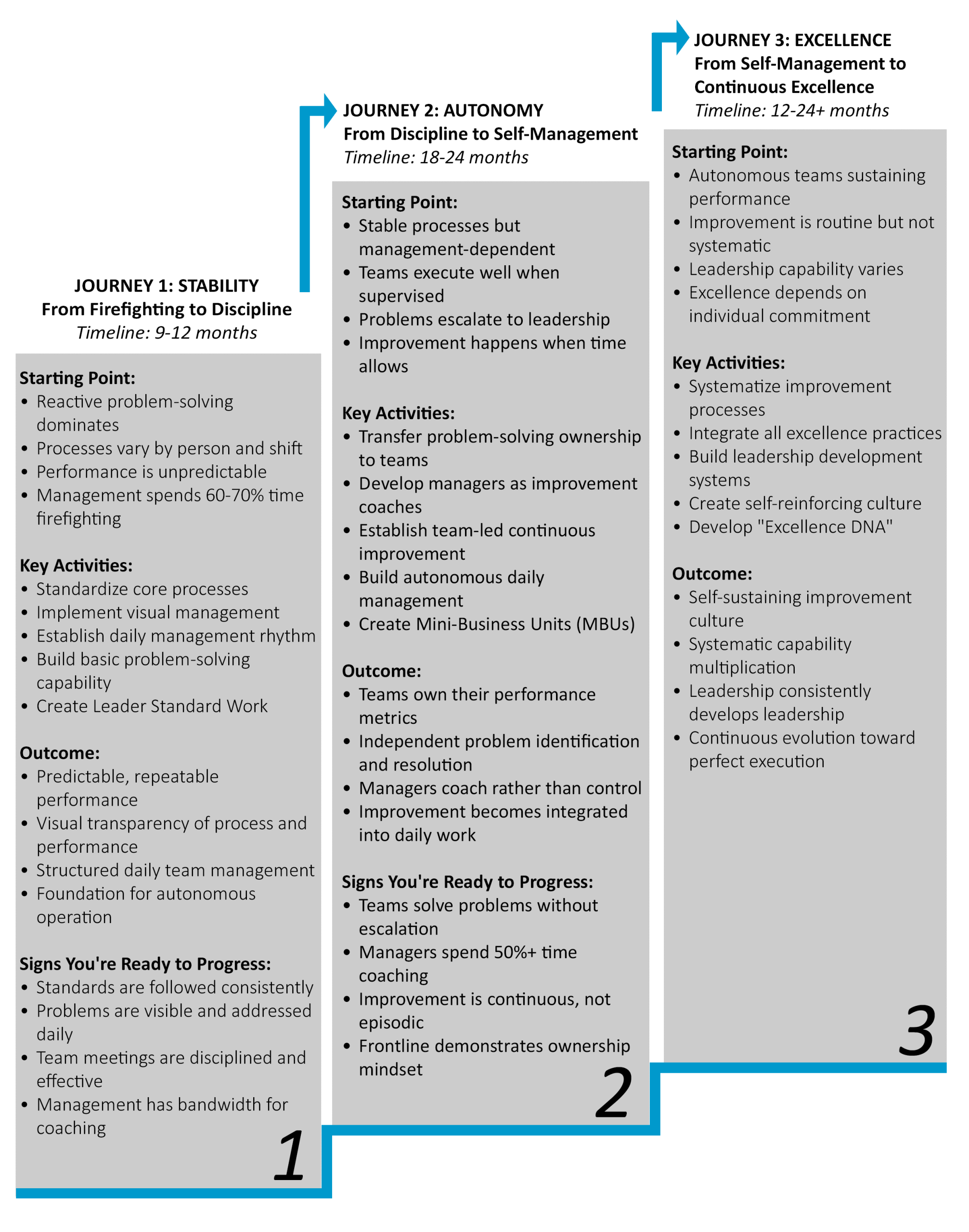
THE THREE-JOURNEY FRAMEWORK
THE EXCELLENCE REALITY
Organizations that reach this journey don’t stop improving—they continuously expand their capability to improve. Performance improvement compounds.
THE BUILDING BLOCKS OF AUTONOMOUS TEAMS
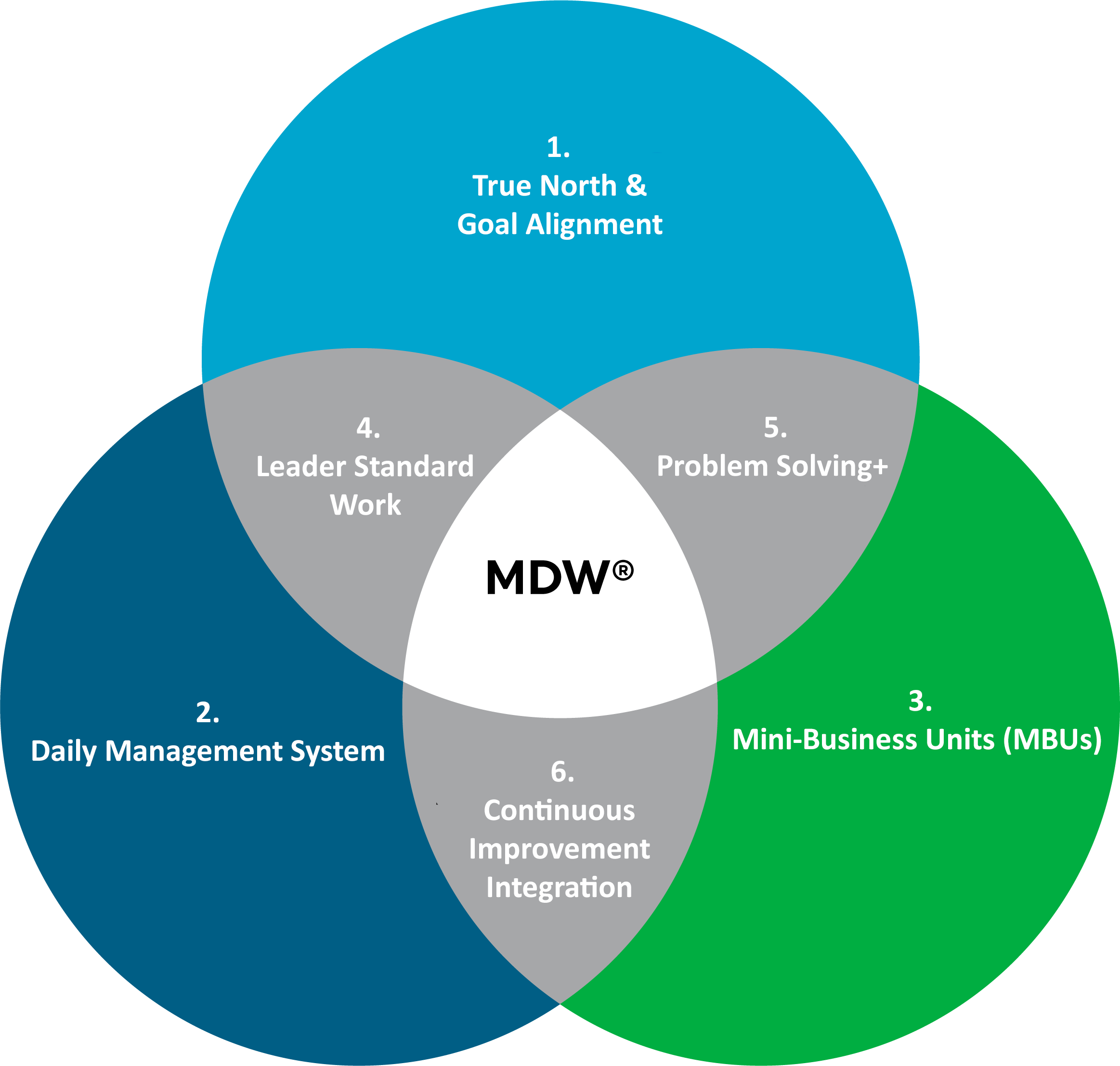
Enterprise direction clarity; Vertical and horizontal alignment; Purpose-driven work
Structured team meetings; Visual performance management; Problem identification and resolution
Team ownership of outcomes; End-to-end accountability; Business thinking at frontline
Predictable leadership presence; Systematic coaching and development; Gemba-based leadership
Structured improvement methods; Root cause analysis; Countermeasure effectiveness
5S and visual workplace; Standard work evolution; Lean workflow optimization; Quality management; Asset care; Safety integration
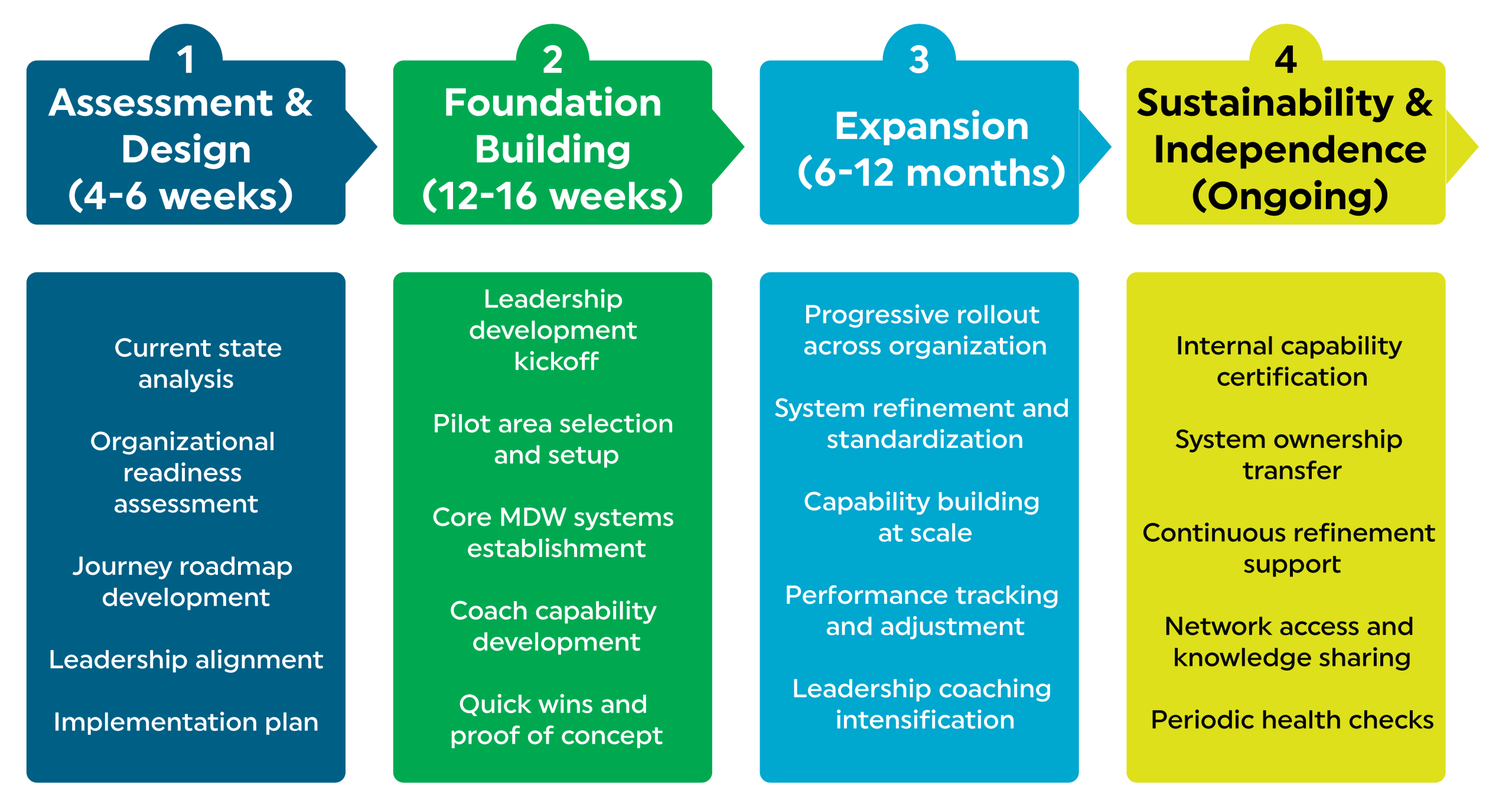
HOW WE BUILD YOUR TRANSFORMATION
KEY PRINCIPLE
We don’t implement FOR you—we build capability WITH you. Our success is measured by your independence, not your dependency.
WHY YOU CAN'T SKIP STEPS
THE TEMPTATION
Many organizations want to jump directly to autonomous teams and continuous excellence.
Why spend 12 months on stability first?
THE REALITY
Autonomy without stability creates chaos, not excellence.
Teams can’t own problem-solving if problems aren’t visible.
Managers can’t coach improvement if basic processes vary by shift.
THE EVIDENCE
Across 150+ implementations, organizations that followed the sequential path achieved sustainable transformation.
Those that skipped stages experienced:
- Initial enthusiasm followed by regression
- Competing priorities overwhelming the change
- Leadership frustration and change fatigue
- Eventual abandonment of the effort
THE INSIGHT
Each journey builds specific organizational capabilities.
Stability builds discipline.
Autonomy builds ownership.
Excellence builds systematic improvement.
You can’t build the third floor before constructing the second.
PERFORMANCE OUTCOMES BY JOURNEY
JOURNEY 1 RESULTS (STABILITY)
- 8-12% productivity improvement
- 15-20% reduction in firefighting time
- 30-40% improvement in meeting effectiveness
- Visible, measurable process performance
JOURNEY 2 RESULTS (AUTONOMY)
- Additional 10-15% productivity improvement
- 50-60% reduction in problem escalation
- 20-30% increase in improvement suggestions implemented
- 25-35% improvement in employee engagement
JOURNEY 3 RESULTS (EXCELLENCE)
- Continuous improvement in all metrics
- Self-sustaining innovation
- Leadership bench strength
- Competitive advantage from operational capability