Excellence Is a Culture,
Not a Programme.
We Build That Culture.
MDW (Mission-Directed Work Teams) is a complete transformation architecture — redesigning the systems, structures, and daily practices through which an entire workforce builds and sustains operational excellence. Not a toolkit. Not a training event. A fundamentally different way of operating.
3500+
Implementations
78+
Countries
150+
Documented Transformations
25+
Years of Practice
THE FUNDAMENTAL CHOICE
Two Roads to Excellence Culture. Only One Leads Where You Actually Want to Go.
Before choosing a partner, you face a more fundamental question — a choice that will determine whether your investment in excellence becomes a permanent capability or another chapter in a long series of expensive starts.
Improvement as a Programme
Specialist-led initiatives, training events, and projects with end dates and budget lines. Results appear. Then they fade. Another programme follows. The cycle repeats indefinitely.
- Results depend entirely on external energy and management attention
- Improvement lives in projects, not in daily work
- Organisational homeostasis quietly reclaims the gains
- Success depends on whether the right leader stays in post
Industry research consistently shows that the vast majority of improvement initiatives fail to deliver lasting results. Most consultancies, researchers, and improvement specialists — however well-intentioned — operate within this paradigm.
Improvement as a Culture
Every person in your organisation — frontline to leadership — pursues brilliance in their work, relentlessly and continuously. Not because a programme is running. Because that is who the organisation has become.
- Improvement is structural — not dependent on external energy
- Self-managing teams own performance and problem-solving
- The operating system sustains after CDI exits
- Excellence is organisational DNA, not initiative fatigue
CDI’s SYSTEMS-DRIVEN APPROACH
Redesigning management frameworks, leadership practices, and daily operating rhythm so excellence becomes the natural way of working — at every level, every day.
THE THREE-JOURNEY FRAMEWORK
The Sequence That Changes Everything
This framework wasn’t designed in a room. It was discovered by honestly examining 150+ documented implementations — our own successes and failures across 25 years of practice. The sequence is not arbitrary. Each journey builds the precise foundation the next requires.
Each journey has defined prerequisites, tools, and measurable outcomes. A Current State Diagnostic confirms your starting point before any commitment is made.
Request a Diagnostic
To explore it in the context of your own organisation, we’ll guide you through a short discovery process.
Download CDI's Three-Journey Framework
How We “Build” Culture
CDI engineers an excellence culture through sequential, structured capability building — where each stage creates the foundation the next requires. Three journeys, each with defined tools, measurable outcomes, and clear prerequisites. And each with a clear leadership mindset that will shape the behaviour needed for each journey.
What This Looks Like in Practice
Organisations that succeed in this approach experience fundamental changes in how work is done every day.
- Daily reporting gets replaced by daily problem-solving. Meetings no longer deal with status updates, as the status is visually clear. In stead, meetings deal with problem-solving and improvement accountability.
- Teams accept ownership of their workplace and output. Teams track their own performance and take steps to improve the outcomes they directly influence.
- Leaders spend time building capability, not firefighting. Leadership shifts from directing work to coaching teams. Time previously spent reacting is redirected toward developing people and systems.
- Improvement becomes part of daily work, not an additional activity. There are no separate improvement initiatives. Improving performance is integrated into how work is managed every day.
- Department-thinking gets replaced by value-stream-thinking. Ultimate customer success unites all value-stream participants and their support role players. Collaboration across department boundaries becomes the norm.
The result is not a better programme. It is a different way of operating — where behaviour changes because the system requires it.
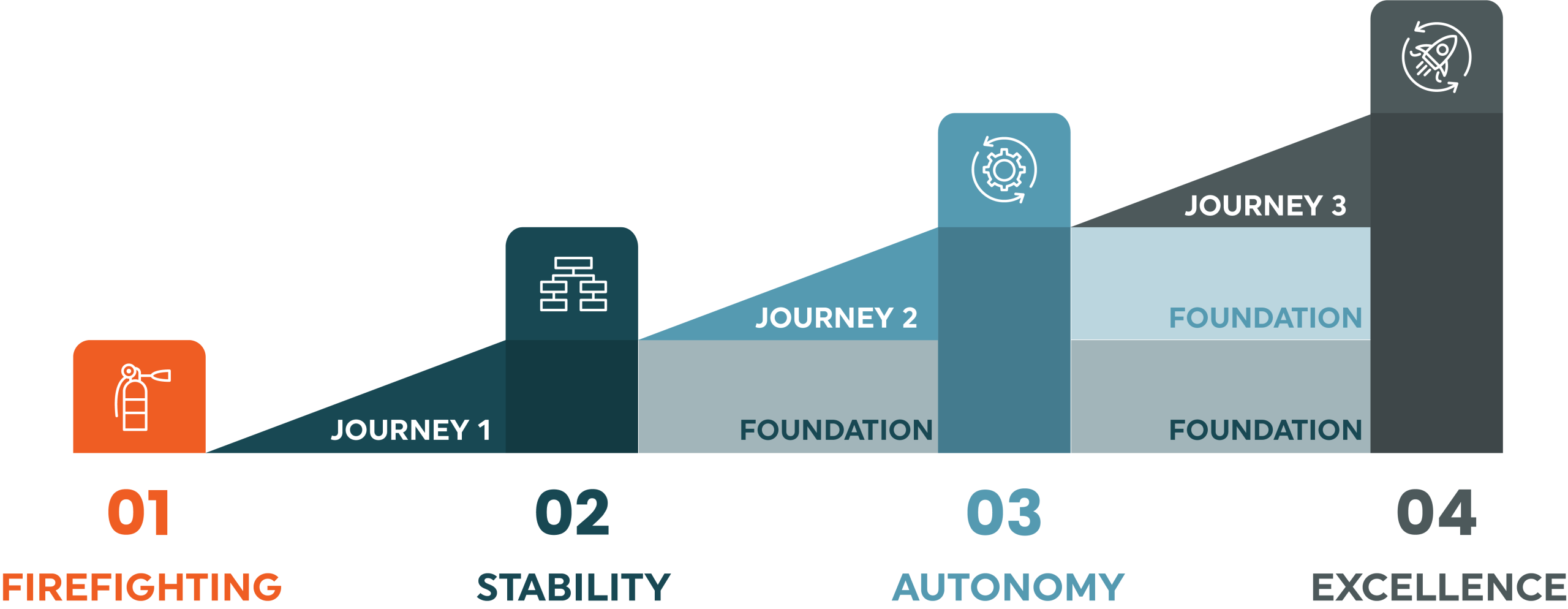
Crawl. Then Walk. Then Run.
Before excellence you need autonomy. And before autonomy you need stability. When you skip a stage, you risk failure. When you follow the path systematically, you build the capability required in the next step during this one.
The mechanism that makes this possible is institutionalised coaching — structured into every leader’s daily practice — developing capability at every level, every day. Not training events. Not performance reviews. Daily coaching that builds the habits of excellence across an entire organisation.
The result is not only a management system. It is an organisation where excellence is simply how everyone works.
Access the CDI White Paper through our discovery process — designed to make sure what you read is relevant to where you actually are.
Download the White Paper
EVIDENCE, NOT PROMISES
What MDW Delivers,
Across 150+ Documented Transformations
60%-90%
SAFETY INCIDENT REDUCTION
50%-80%
QUALITY DEFECT REDUCTION
25%-45%
PRODUCTIVITY IMPROVEMENT
20%-40%
ASSET UTILISATION GAIN
300% profit increase
Over a 5-year transformation at a South African food manufacturer
89% defect reduction
At a major automotive OEM paint shop — from widespread defects to near-zero
300–1,000%+ ROI
Consistently documented across client engagements, in the first year alone
Across automotive, food & beverage, pharmaceuticals, mining, logistics, chemicals and 18 other industry groups. 47 countries. 6 continents.
“IN PLAIN TERMS”
“So what you are actually saying is…”
Most improvement approaches fail because they target performance without changing behaviour — and behaviour only changes when the systems that surround people change. MDW starts there. The Daily Management System is not a reporting tool or a set of Lean practices. It is a complete operating architecture that redesigns how work is managed, how performance is owned, and how improvement happens — every day, at every level, by everyone.
“Culture doesn’t change through training or communication. It changes when enough people behave differently, consistently, over time — and the only reliable way to achieve that at scale is to change the systems within which people operate.”
The vehicle for that change is self-managing teams — Mini Business Units — where ownership, accountability, and problem-solving are structural realities, not aspirations. But self-managing teams cannot function in unstable operations. Which is why stability comes first, autonomy second, and excellence — the coaching-led culture of continuous improvement — only becomes possible once both foundations are in place.
This is not a theory. It is the sequence that emerged from what actually worked — and what didn’t — across 150+ implementations. The logic compounds. Skip a stage and the whole structure weakens. Follow it, and capability builds on capability until excellence becomes self-sustaining.
THE SHORT VERSION
Most organisations improve. Few transform. The difference is not effort, methodology, or intent — it is sequence, system, and the courage to mobilise everyone.
Define excellence as culture. Build stability first. Develop autonomous teams. Embed daily coaching at every level. Integrate everything through one operating system. That is the mechanism. That is what CDI builds.
HOW TO ENGAGE
Three Ways to Partner with CDI
Whether you lead operations, practise as a consultant, or run a regional firm — there is a model designed for where you are.
FOR OPERATIONAL LEADERS
Build a Lasting Excellence Culture
- Start with an honest diagnostic — not a sales presentation
- Engage journey-by-journey or as a full transformation partnership
- Develop leaders who build capability, not dependency
- A system designed to sustain after CDI exits
FOR EXPERIENCED CONSULTANTS
Licensed Methodology. Protected Territory.
- Full MDW implementation rights with comprehensive training
- Protected regional territory — no internal competition
- Ongoing support within a global practitioner community
- 25+ years of field-tested methodology, yours to deliver
FOR REGIONAL FIRMS
World-Class Methodology. Your Market.
- Co-branding, train-the-trainer, and regional licensing models
- Deliver MDW in your market with full CDI backing
- Enhance your offering without reinventing the methodology
- Collective intelligence of a global practitioner network