
Every organisation starts from a different place. Some are firefighting daily. Others have achieved stability but can’t break through to genuine autonomy. Some have capable teams but no systematic path to excellence. And a few have tried transformation before and watched it regress.
- Executive Briefing: The ideal starting point if you’re still assessing whether this approach suits your organisation.
- Current State Diagnostic: Understand your current position before choosing your future direction.
- Journey-by-Journey: Progress through each phase of the Three-Journey Framework separately, at a pace that fits your organisation.
- Full Transformation Partnership: A 36 to 48-month collaboration— shifting from firefighting to a culture of excellence.
- Transformation Rescue & Relaunch: For organisations where a previous initiative stalled. Diagnose what went wrong, relaunch on solid foundations.


Executive Briefing
For leadership teams that need shared understanding before making commitments.
Transformation requires leadership alignment — not just the decision-maker’s conviction, but the senior team’s shared understanding of what the journey demands. The Executive Briefing brings CDI practitioners to your leadership team for a structured session that covers the Three-Journey Framework, the evidence behind it, and an honest discussion of what commitment looks like.
This is not a sales presentation. It is a working session designed to surface the questions, concerns, and misalignments that — left unaddressed — would undermine any transformation before it begins.
Details
Duration:
Half-day or full-day
Deliverable:
Leadership alignment on transformation approach, readiness, and next steps
Best for:
Organisations where the decision-maker is convinced but the broader leadership team needs to understand what they’re committing to
Once leadership alignment is achieved through the Executive Briefing, the next step is to schedule the Current State Diagnostic.
Request an Executive Briefing
Current State Diagnostic
Every Engagement Begins With Honesty
Before CDI recommends a path, we need to understand where you actually stand — not where your leadership team believes you stand, and not where your last consultant’s report said you stand.
The Current State Diagnostic is a structured, on-site assessment conducted by an experienced CDI practitioner. It evaluates operational stability, team capability, leadership practice, and cultural readiness across your operation. It positions your organisation on the Three-Journey Framework and identifies the specific capability gaps that would undermine transformation if unaddressed.
Why we insist on this
Our own research revealed that a significant proportion of failed implementations began at the wrong journey. Organisations that lacked operational stability attempted to build team autonomy. Organisations that lacked autonomous teams attempted to embed excellence. In every case, the starting point was chosen based on ambition rather than honest assessment.
The diagnostic protects you from that mistake. It also protects CDI — we would rather decline an engagement than begin one we know will fail.
What it covers
- Operational stability and daily management maturity
- Team capability and problem-solving practice
- Leadership practice and coaching readiness
- Cultural indicators and change readiness
- Specific journey positioning with evidence
- Honest gap analysis with recommended starting point
Duration: 2–5 days on-site depending on scale
Deliverable: Diagnostic report with journey positioning, capability gaps, and recommended transformation path
Request a Diagnostic

Journey-by-Journey Transformation Services
Building Your Excellence Culture — At Your Own Pace, From Your Starting Point
CDI’s transformation services follow the Three-Journey Framework — engage for the full journey or begin at your most pressing point. The diagnostic confirms the right entry.”
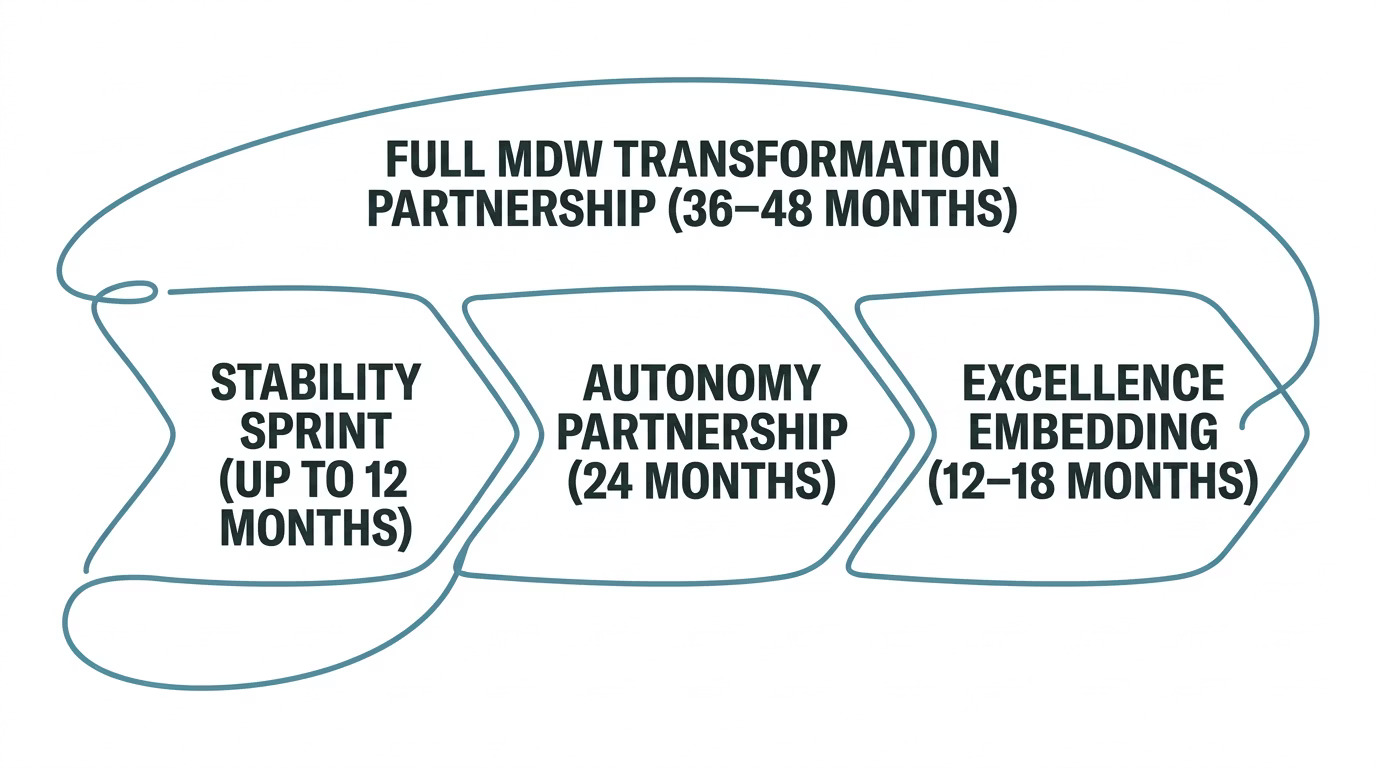
Journey 1 – Stability Sprint
For organisations in firefighting mode that need operational discipline before anything else.
If your leadership bandwidth is consumed by daily crises, your output is unpredictable, and every shift feels like a different operation, this is your starting point. Journey 1 establishes the operational foundation without which no transformation can take hold.
What it covers
- 5S visual workplace implementation.
- Standardised work procedures for critical tasks.
- Daily management routines with defined agendas and escalation.
- Leadership routines establishing frontline presence.
- Accountability processes connecting daily execution to strategic objectives.
Key Details
Typical duration: Up to 12 months
Prerequisites: Leadership commitment to daily management discipline
Best for: Organisations where operational instability is the primary barrier to improvement
Outcome: Stable, predictable operations with visible management systems, standardised work, and daily management routines embedded across the facility.
What comes next
Journey 1 creates the foundation for Journey 2. Many organisations choose to continue immediately. Others pause to consolidate stability before progressing. The diagnostic at Journey 1 completion confirms readiness.
Request Journey 1 Discussion
Journey 2 – Autonomy Partnership
CDI’s core standalone offering — and the transformation that changes everything.
Journey 2 is where operational ownership transfers from management to teams. This is the critical anti-homeostatic transition: the source of organisational stability shifts from managerial control to team capability. When teams manage their own performance, solve problems systematically, and improve their work as a matter of course, management bandwidth is freed for strategic development and the transformation begins to accelerate itself.
This is also the journey most likely to be undermined by old management thinking. New tools with old thinking is the single most common reason Journey 2 stalls.
Leaders approving autonomous teams while continuing to direct and control from above gradually pull the organisation back to its previous operating state. The antidote is institutionalised coaching — a structured daily practice that replaces directing with developing. CDI’s practitioner presence ensures this pattern is surfaced and addressed as it emerges, not after the damage is done.
What it covers
- Standardised management frameworks for teams, including goal setting, performance tracking, problem-solving, and escalation.
- Development of systematic problem-solving methodologies and visual management systems owned and operated by teams.
- A structured transition from directive supervisor to capability-building coach; includes a structural move to Mini-Business Units (MBUs).
- Clearly defined escalation processes to prevent both abandonment and over-dependence.
Key Details
Typical duration: 18 to 24 months
Prerequisites: Operational stability confirmed by diagnostic. Teams must be operating predictably before ownership can be transferred. Organisations that have not completed Journey 1 — or its equivalent — will be assessed for stability before Journey 2 begins.
Best for: Organisations with stable operations where performance still depends heavily on supervisory oversight and management direction — and where leadership is ready to shift from directing to developing.
Outcome: Self-managing teams that own their performance, solve problems independently, and improve their work as a matter of course. Leadership bandwidth freed from firefighting and redirected toward strategic development.
Note: Journey 2 is CDI’s most transformative standalone engagement. Many organisations enter at this stage and continue through to Journey 3. The diagnostic at Journey 2 completion confirms readiness for Excellence Embedding.
Request Journey 2 Discussion
Journey 3 – Excellence Embedding
The journey most organisations never undertake — and the reason most transformations eventually fade.
Journey 3 is where autonomy becomes excellence. Where capable teams become continuously improving teams. Where daily management becomes daily coaching. And where the organisation’s default state shifts from comfort-seeking to excellence-seeking.
This journey exists because our research revealed that even successful Journey 2 implementations eventually regress without a deliberate pivot to excellence. The early results are so transformative that the next step is forgotten. Performance plateaus. The effort-to-payoff ratio becomes less obvious. And the organisation gradually reverts to familiar practices.
Journey 3 prevents this by embedding excellence as organisational identity.
What it covers
- GTS⁶ coaching disciplines: six daily leadership practices that develop the habits of excellence at every level, every day.
- E³ culture embedding: Everyday improvement by Everybody through genuine Engagement.
- Advanced problem-solving and improvement methodology.
- Performance system maturity: teams setting and pursuing stretch targets independently.
- Sustainability architecture: ensuring improvements become the new operating standard.
- Planned CDI withdrawal with self-sufficiency verification.
Key Details
Typical duration: 12–18 months
Prerequisites: Genuine team autonomy (confirmed by diagnostic). Organisations must reach autonomy before Journey 3 or risk only surface-level change.
Best for: Organisations with autonomous, capable teams ready to embed excellence as permanent organisational identity.
Outcome: Excellence as how the organisation operates, sustained after CDI exits.
Note: CDI begins Journey 3 only after your organisation demonstrates capability in Journey 2. This ensures readiness for the next stage.
Request Journey 3 Discussion
Full MDW Transformation Partnership
For organisations ready to commit to the complete journey from current state to an excellence culture.
The full transformation partnership takes your organisation through all three journeys in sequence — Stability, Autonomy, and Excellence — with CDI practitioners embedded alongside your teams throughout. This is the most comprehensive engagement and delivers the deepest, most sustainable results.
How the Partnership Works
Foundation
- Current State Diagnostic and Transformation Roadmap
Full Journey
- Implement Journeys 1, 2, and 3 in sequence, with an on-site CDI practitioner present throughout. Each journey is confirmed complete by diagnostic before the next begins — no stage is skipped or declared complete prematurely.
Leadership Pipeline
- Development from supervisor to coach, structural transition to Mini-Business Units, GTS⁶ coaching discipline development.
Milestones
- Measurable milestones and progress tracking at each stage, with planned CDI withdrawal as the organisation attains self-sufficiency.
Key Details
Typical duration: 36–48 months
Best for
Organisations seeking complete cultural transformation with committed leadership and a long-term view
Outcome
An organisation where excellence is how everyone works — sustained after CDI exits
Request Full Transformation Discussion
Transformation Rescue and Relaunch
For organisations whose previous transformation efforts have stalled, regressed, or failed.
Not every organisation approaching CDI is starting from scratch. Some have invested heavily in a prior transformation — such as Lean, Six Sigma, TPM, WCM, or other methodologies — only to see progress plateau or reverse. The tools were effective. The implementation was not sustained.
CDI’s Transformation Rescue begins with a diagnosis that examines what was implemented, what was held back, what regressed, and why. In most cases, the underlying capability gaps directly relate to the Three-Journey Framework: stability was presumed rather than established, autonomy was declared rather than cultivated, or excellence was expected to emerge naturally from a functioning system.
The rescue does not discard previous investment. Instead, it diagnoses the missing elements, accurately positions the organisation within the framework, and builds on existing foundations.
What is covers
- Detailed analysis of previous transformation: what persisted, what reverted, and why?
- Candid evaluation of current capacity versus expected capacity.
- Positioning of the journey based on the actual state, not previous ambitions.
- Customised relaunch plan that builds on existing strengths, considering change fatigue and organisational scepticism.
Prerequisites
- Leadership willingness to confront the root causes of failure directly, including the possibility that management thinking — not just implementation — was part of the problem.
- Acceptance that the relaunch will follow the correct sequence regardless of where the previous effort reached.
- Sufficient organisational goodwill remaining to attempt transformation again.
Best for: Organisations that have invested seriously in a previous transformation, understand that something fundamental went wrong, and are committed to understanding why before investing again.
Outcome: A clear diagnosis of why the previous effort failed to sustain, accurate journey positioning based on actual current capability rather than previous ambitions, and a structured relaunch plan that builds on existing foundations while directly addressing the root causes of regression.
Request a Rescue Diagnostic
Readiness Assessment
For organisations wanting to understand their starting point before engaging.
The Readiness Assessment is designed for organisations that want an honest external perspective on where they stand before committing to a full diagnostic. It is a structured self-assessment that positions your organisation on the Three-Journey Framework across four dimensions: operational stability, team autonomy, leadership capability, and cultural readiness. It provides an initial indication of your journey starting point and the capability gaps most likely to need attention.
The assessment is completed online and takes approximately 15 minutes. Your responses are reviewed personally by a CDI regional leader — not processed by an algorithm — who provides an individualised perspective on what your results suggest and what questions they raise within 48 hours. This review is the first stage of CDI’s structured discovery process, through which the right engagement path for your organisation becomes clear.
4 Dimensions | 15 Minutes | Personalised Response Within 48 Hours | First Step of Your Discovery Process
Best for: Organisations exploring whether CDI’s approach fits their situation.
Take the Readiness Assessment