Culture Built Daily.
Mission-Directed Work Teams is not a toolkit, a training programme, or a set of improvement practices. It is a complete transformation architecture — the systematic method through which CDI builds cultures of operational excellence.
Request a Diagnostic
THE NORTH STAR
What If Every Frontline Action Was Flawless?
Imagine a reality where every person working on your frontline — the value-creating heart of your business — performs every single task, every single step, perfectly. No errors. No delays. No rework. Perfect execution, perfectly on time.
In this reality: zero defects, 100% on-time delivery, customer loyalty soaring, costs plummeting, and a competitive position that is virtually unassailable. Traditional management — monitoring, correcting, firefighting — would become obsolete. Leaders would become coaches, capability developers, and culture builders.
Achieving this reality may be theoretically impossible. But moving significantly closer to it? That is not just possible — it is imperative. And it starts with understanding the journey.
The Gap Is Enormous
How much does your organisation currently invest in compensating for imperfect operations? Customer service managing complaints. Rework teams fixing defects. Quality control inspecting everything. Managers firefighting daily crises.
We call that Managing the Gap. MDW systematically closes it — not by working harder, but by changing the system that produces the gap.
WHY MOST APPROACHES FAIL
The Programme Trap
Most organisations pursue the Perfect Execution Vision through programmes — specialist-led improvement projects with end dates and budget lines. The tools are sound. The principles are valid. But the evidence for lasting transformation is another matter entirely. The vast majority of implementations fail to deliver lasting results.
The reason is straightforward: programmes change processes. They don’t change culture. And without cultural change, the organisation’s default operating state reasserts itself the moment external energy — the programme, the consultant, the management attention — is withdrawn.
Organisational Homeostasis
This is not a failure of willpower. It is a structural force: the system’s natural tendency to return to its familiar state, regardless of whether that state is functional or healthy. The organisation doesn’t reject change. It absorbs it, dilutes it, and returns to its previous form. Any methodology that ignores this force is designing for short-term results and long-term regression. MDW was designed around it.
Three Journeys to an Excellence Culture
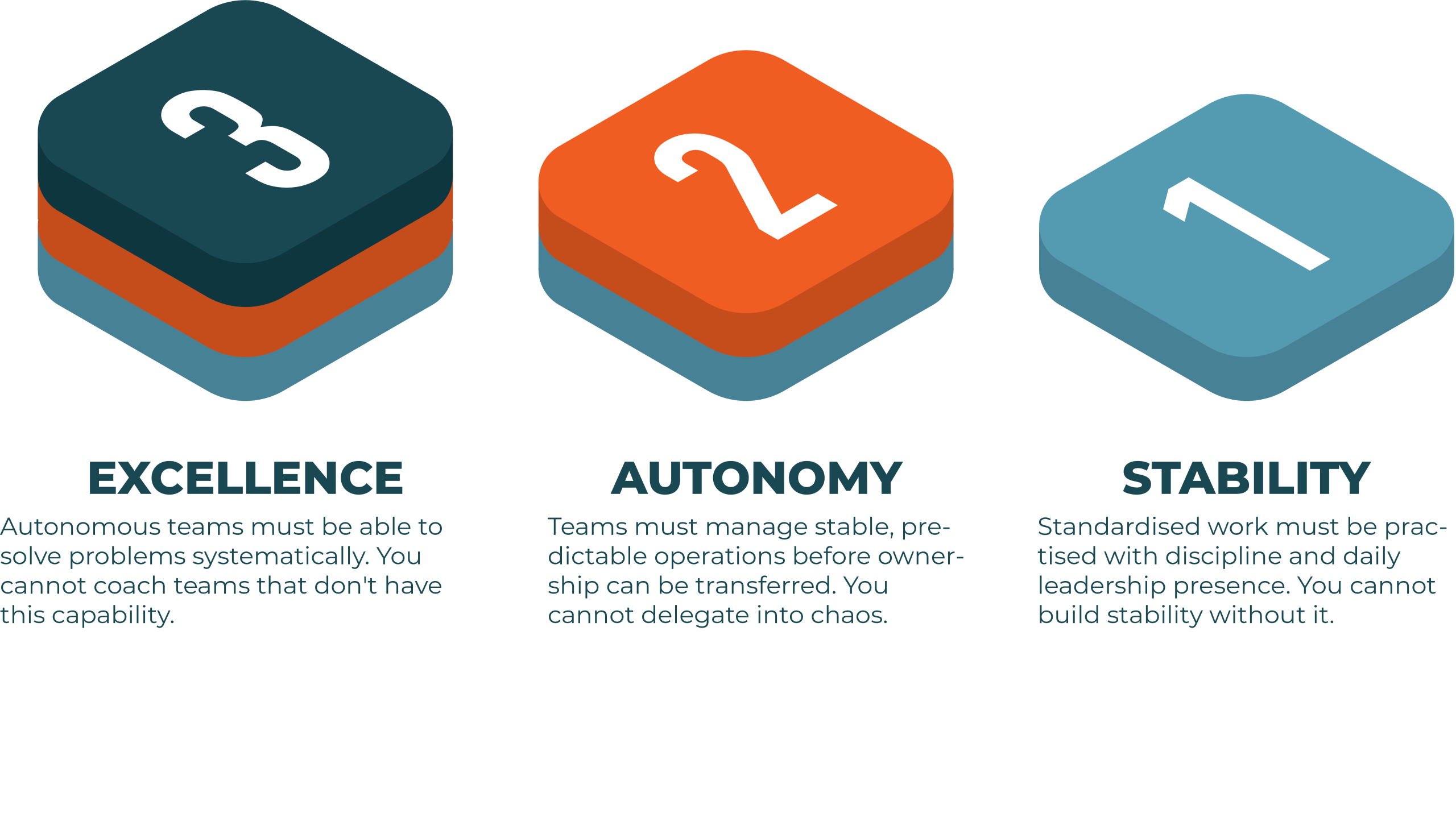
The Three-Journey Framework didn’t emerge from theory. It was discovered by analysing 150+ documented case studies spanning 47 countries — honestly examining what worked, what failed, and why. The sequence is not arbitrary. It is the only sequence that builds sustainable capability while systematically overcoming organisational homeostasis.
Working backward from what excellence actually requires, the logic becomes clear:
01
JOURNEY 1 · UP TO 12 MONTHS
Stability
From Firefighting to Operational Discipline
The Challenge
Operations are unpredictable. Leadership bandwidth is consumed by daily crises. Every shift is a firefight. There is no foundation on which to build anything lasting. Attempting cultural transformation in this state is not just difficult — it is structurally impossible.
What MDW Does
- 5S Visual Workplace — normal and abnormal conditions immediately visible
- Standardised Work Procedures — best-known methods for critical tasks
- Daily Management Routines — structured meetings with clear agendas and escalation triggers
- Leadership Routines — defined frontline presence patterns that develop capability
- Accountability processes connecting daily execution to strategic objectives
The Outcome
Predictable, measurable operations. Firefighting replaced by disciplined daily execution. Leadership bandwidth freed from crisis management. The organisation now has a stable foundation — and critically, regression now means losing something tangible, not just an aspiration.
Not all organisations need Journey 1. Those with existing operational stability and predictable daily management begin at Journey 2. The Current State Diagnostic confirms the right starting point.
02
JOURNEY 2 · UP TO 24 MONTHS
Autonomy
From Compliance to Self-Managing Teams
The Challenge
Operations are stable, but performance depends on supervisory oversight. Teams execute reliably when directed but don’t yet own their performance, solve problems independently, or drive improvement from within. Management bandwidth is consumed by directing rather than developing.
What MDW Does
- Structured goal-setting that teams co-develop, own, and track themselves
- Visual performance tracking that highlights deviations and makes them actionable
- Systematic problem-solving methodology — root causes, countermeasures, updated standards
- Defined escalation processes — teams resolve issues without abandonment or over-dependence
- Leadership pipeline development — directive supervisors become capability-building coaches
Journey 2 introduces the transition from silos to Mini-Business Units — reorganising around value streams so team capability, not managerial control, creates stability.
The Anti-Homeostatic Transition
This is the critical shift: the source of organisational stability moves from managerial control to team capability. When teams manage their own performance and solve problems systematically, the organisation becomes structurally harder to regress — because regression would mean dismantling a capability that teams now own and value.
The Outcome
Self-managing teams. Leaders operating as coaches and capability builders. Management bandwidth freed for strategic development. The transformation begins to accelerate itself.
03
JOURNEY 3 · 12–18 MONTHS
Excellence
From Autonomy to Organisational DNA
The Challenge
Teams are autonomous and capable. Processes are stable. However, improvement is an activity rather than an identity. Without a clear focus, the organisation stalls and progress decelerates. The final step requires embedding excellence not as a practice, but as the organisational character itself.
What MDW Does
Journey 3 is where coaching becomes the primary leadership practice — not an add-on, but a replacement. Excellence is embedded as organisational identity through six defined coaching disciplines practised daily at the frontline. Together they form GTS⁶. Each discipline is observable, measurable, and developed through practice.
The Outcome
Excellence is no longer a programme, an initiative, or even a strategy. It is how the organisation operates. Homeostasis itself is reconfigured — the system’s default state becomes excellence-seeking rather than comfort-seeking. The organisation sustains and improves after CDI exits because the culture is built into the operating rhythm, not held in place by external support.
JOURNEY 3 · 12–18 MONTHS
GTS⁶ — Daily Leadership Practice
Each discipline is practised daily at every leadership level. Each is observable, measurable, and developed on the job — not in a training room.
Go to See
Leaders are present at the frontline, observing actual conditions rather than relying on reported data. Reality, not abstraction, drives every decision. You cannot coach what you cannot see.
Grasp the Situation
Taking the time to deeply understand current conditions before acting — resisting the impulse to jump to solutions. The quality of every intervention depends entirely on the quality of this step.
Get to Solution
Coaching teams to solve problems rather than solving for them. Every problem is an opportunity to build capability, not just to resolve an issue. The aim is a team that no longer needs your answer.
Get to Standard
Capturing learning so that every improvement becomes the new baseline. Without this discipline, gains are personal and temporary. With it, the organisation continuously raises its floor.
Get to Sustainability
Embedding improvements into daily practice so they persist without supervision. The test of any improvement is not whether it works — it is whether it holds when attention moves elsewhere.
Get to Stretch
Continuously raising the bar once current standards are stable. This discipline keeps the organisation moving toward the Perfect Execution Vision rather than settling at good enough.
THE THREE CULTURAL CONDITIONS
GTS⁶ Establishes E³ —
The Cultural Identity of Excellence
E¹
Everyday
Improvement becomes routine, habit, and identity. Not a quarterly initiative. Not a project kickoff. The way work is done, every single day, at every level.
E²
Everybody
Everyone improves their work and themselves — from the frontline operator to the executive team. Improvement is not a specialist function. It is a universal practice.
E³
Engaged
Genuine interest and ownership, not compliance. People improve because they care — because the system has made meaningful participation the path of least resistance.
THE INTEGRATION ENGINE
The Daily Management System
Most organisations implement improvement tools separately — Lean here, Six Sigma there, TPM somewhere else. Each competes for management attention. Each has its own meetings, metrics, and reporting. The result is fragmentation: individually valid practices that collectively exhaust the organisation without producing integrated capability.
“The DMS integrates everything — strategy to daily execution, coaching to capability development, everyone to transformation simultaneously.”
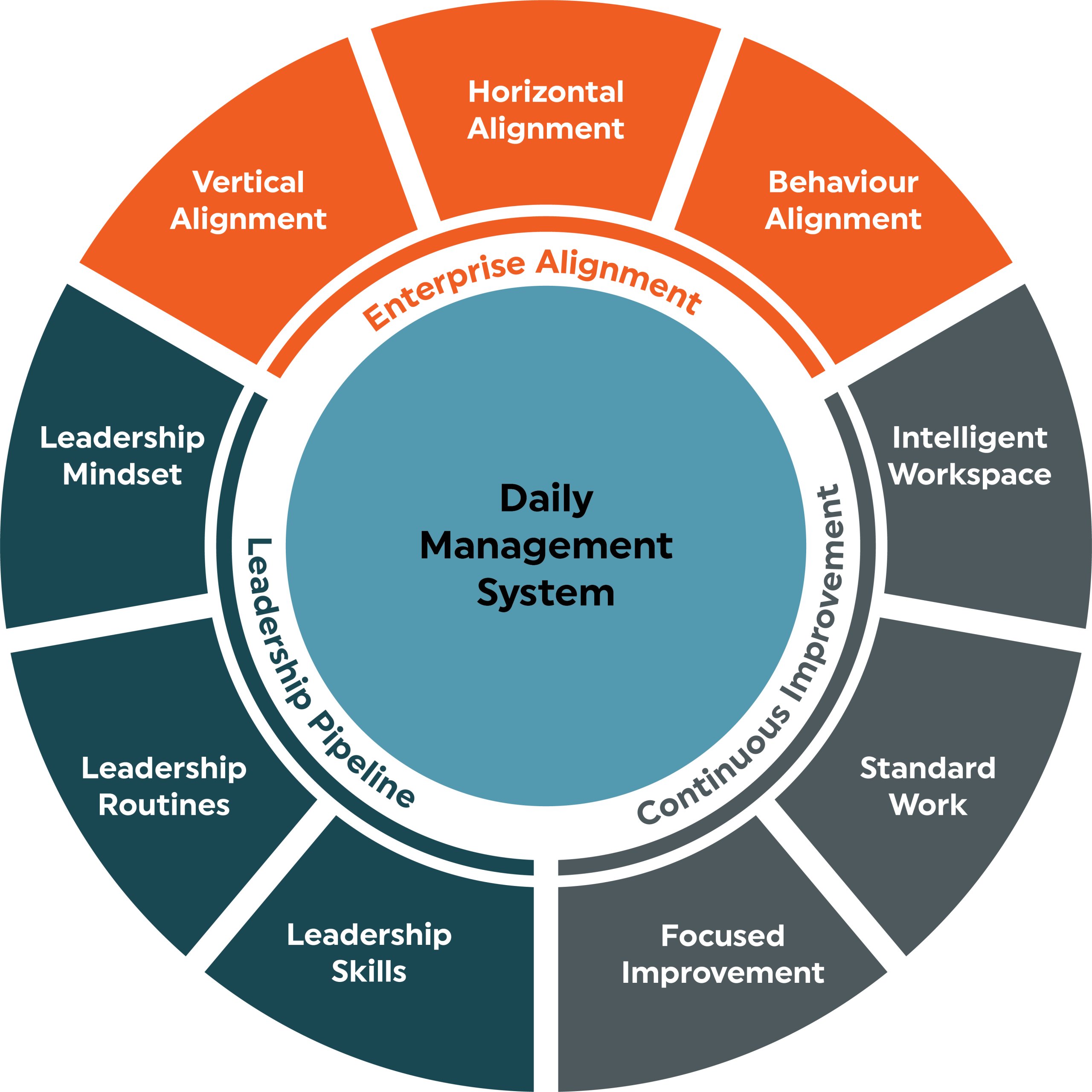
The Daily Management System is not a reporting tool or a set of Lean practices. It is a complete operating architecture. One system that mobilises everyone, rather than isolated tools competing for attention. Through the DMS, improvement doesn’t run alongside work — it is embedded into the way work is managed and performed every day.
This integration is what allows MDW to overcome organisational homeostasis. When excellence is woven into the daily operating rhythm — not added on top of it — the system’s natural tendency is to sustain the new way of working, not return to the old one.
The Question Isn’t Whether It Works. It’s Whether You’re Ready.
The Three-Journey Framework has delivered measurable, sustainable results across 3500+ implementations in 78 countries, in every major industry, and in every cultural context we’ve encountered. The methodology works.
The real question is whether your organisation — and specifically your leadership — is ready to commit to sequential capability building rather than looking for shortcuts. Ready to change management thinking, not just operational processes. Ready to invest in building a culture that sustains, rather than a programme that impresses.
If the answer is yes, the next step is understanding where you stand today.
The Readiness Assessment is the first step — a structured process that delivers your personalised framework and confirms the right starting point for your organisation. The diagnostic conversation follows from there.
Take the Readiness AssessmentRequest a Diagnostic